Good afternoon, beloved -
Every once in a long while, a fertile new set of ideas starts to arise at the intersection of two or three previously unrelated bodies of thought and practice. These are the best times for me, but they’re unreliable in their timing, and fragile in their ability to be sustained. I can neither predict when one of these alignments is going to happen, nor do much to encourage whatever ambient primitives happen to be traversing my field of vision to fall into place and cohere. But maybe it’s starting to happen again?
A few weeks back, my friend Marco Ferrari kindly invited me to Eindhoven, to be an external examiner on the graduating projects his MA Information Design students were submitting to the Design Academy there. A number of them were genuinely quite good, worked out in a pleasing amount of detail in each of the (very different) registers of concept, textual explanation, physical execution and presentation. And among my very favorites was a project by Luca Weste, called “Waves of Resistance”: both homage to, and canny attempt to update, the pirate tradition Bologna’s legendary Radio Alice operated in during its brief efflorescence in 1976-‘77, and the intimate, quietly radical “small listening conditions” the Italian pirate stations afforded their audience.
As part of his project, Luca devised a working, rapidly mountable/demountable AM radio transmitter and antenna array, which looked like this:
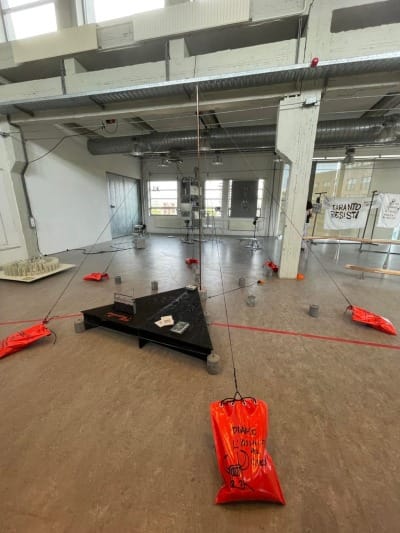
Take a closer look at the vinyl sandbags Luca fabricated to tension the antenna’s guy lines, especially. (This one’s screened with the slogan Rivendichiamo! Strutture Liberanti, or, roughly, “We Claim Liberating Structures!’)
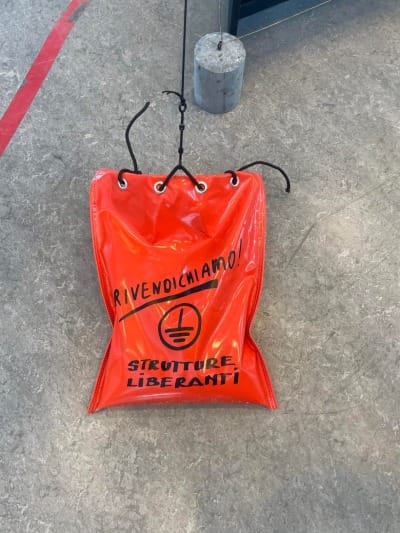
I think you know I love work like this, where the clarity of concept is matched to a certain rigor in execution, and there’s an overall unity between the work’s rhetorical, material, operational and aesthetic qualities. Top marks as an academic project, certainly! But there’s an additional quality about Luca’s setup that I appreciate on an even deeper level: keeping the history of state violence directed at pirate radio in general, and Radio Alice in particular, very much in mind, all I could think about in Eindhoven was how readily you could transmit for awhile, break all of that down, pack it into the box of a cargo bike, and be off before authority could range you. And I couldn’t stop daydreaming about the other autonomous community institutions you might conceivably design so their physical plant could fit in the box of a cargo bike: small cafés and food stands, of course, but also digital-fabrication workshops, free clinics...schools.
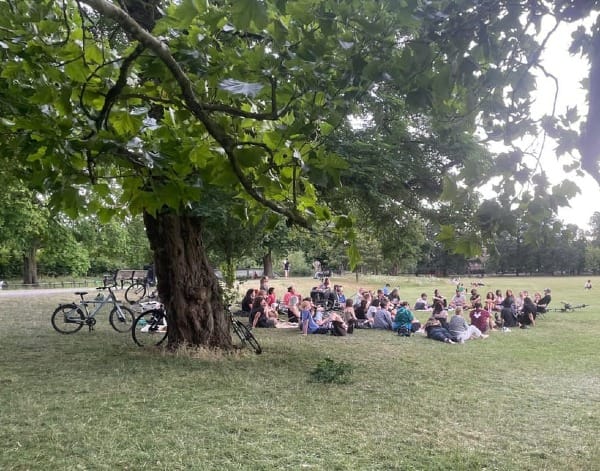
I was still thinking about it last Monday, when I gave a free Lifehouse talk right here in Clissold Park, as part of the London School of Solarpunk’s Summer Series. This was completely brilliant: the organizers managed to convene something just north of fifty people in the end, to sit in a circle on the grass and talk ideas on a pleasant summer evening. It wasn’t the greatest talk I’ve ever given in my life, necessarily. But the vibe throughout was something close to pure joy nevertheless, and it looked like this:
And I thought, as I so often do when all the tumblers start to fall into place, why are these moments so few and far between in a life? Why don’t we do this kind of thing more often, firstly? But why is it, too, that collective learning has thrown off any detectable influence of Freire or hooks or Illich, and become once more so ponderous, so exclusive, so vertiginously, insanely expensive? What is it that prevents us from gathering in the open air, the moment conditions permit it, and working through some concepts together, for the simple pleasure of doing so?
Then the other day I saw this guy riding up Kingsland Road in Dalston, and the final piece of the puzzle fell into place:
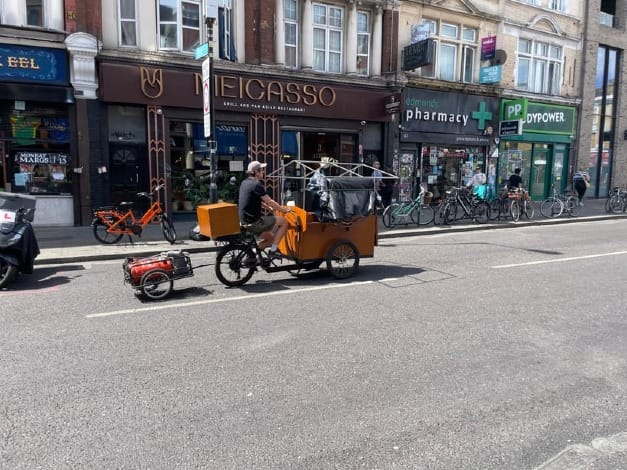
Look at that bike! Look at that trailer! It looks like he’s got everything he needs for an cozy little espresso stand — a congenial, convivial microurban condition — tucked away between them, and good to go on a few moments’ notice. All in all, it’s a splendid example of what I’ve been calling “minimum viable utopia,” or little glimpses of the better world we were meant to live in, irrupting through the screen of the ordinary. But it’s something else too: proof of concept.
So the thought I’m tinkering with now is this: exploring how different autonomous and self-organized community functions can be made as compact, ultra-lightweight and bike-portable as is suggested by this image, then doing a run of zines to share what I’ve learned.
One of my polestars here, as has been pretty consistently the case for the past several years now, is raumlaborberlin’s brilliant project Floating University, a cluster of very lightweight structures built on a wastewater-retention pond on the former site of Tempelhof Airport. After having read about Floating for half a decade, I finally managed to make a visit work out a few summers back, and I can only hope my friend Andrey can forgive me for the rather Tiggerish energy I bounced around with.
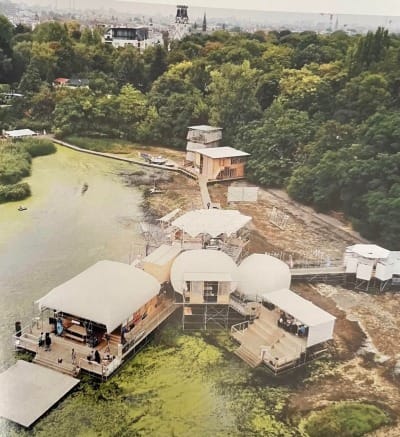
What raumlabor does so brilliantly here, as on all of their projects, is to bring designerly intelligence to a fundamentally open, ad hoc, user-configurable toolkit of spatial elements. It’s what Luca did in devising his transmitter/antenna setup as well, in a different key. What I want to do in these zines is apply that same kind of designerly intelligence to the qualities of an experience that run just either side of the seam between the physical and the social.
How can we imagine community-based counterinstitutions that derive their gross spatial form entirely from the desire of the people using and inhabiting them, but are sufficiently refined in the details to permit designerly experience and hard-won practical nous to shine through and facilitate their expression of that desire? Or put differently — put in the phrasing that I’ve (figuratively) hung up over my workbench for a quarter-century now — what is the minimum amount of structure one can assert into a situation to allow meaning and organization and the capacity to endure to emerge organically? And the new element: how can that structural minimum be abstracted down to something you can wheel around with you as the need arises?
And so, the School at Hand: a free community school smaller than architecture, larger than furniture, more mobile than either. Forty co-learners. One human-powered cargo bike. An estimated twelve minutes from arrival onsite to completed deployment.
The non-negotiable design desiderata I set for myself in the School at Hand “brief” were as follows: offer complete provision for approximately forty participants, including lightweight shelter, seating, the faculty of amplified speech, and all necessary working materials. Provide for rapid assembly and disassembly by ordinary, untrained teenagers or adults. Ensure that all necessary equipment can be carried by a single, human-powered cargo bike. Ensure that all components can be understood, repaired and replaced with ordinary, commonly-available tools. Ensure that the school refuses the theater of power, and affords the facilitator no structurally privileged position. Design everything so that the setup remains visibly, manifestly provisional, appropriable and accessible.
Following a line of intuition that emerged as I was watching how passersby in Clissold Park reacted upon seeing a few dozen people sat in a circle, the School at Hand is part classroom, part assembly and part conspicuous, even contentious public claim/advertisement for itself. The nascent School arrives as a single cargo-bike load, admittedly somewhat bulkier than would be ideal, but everything about it remains visibly, tangibly incomplete until participants show up to animate it. Before assembly it’s just a load of poles, cloth panels and boxes; the forty co-learners literally produce the institution, and there is no distinction between the act of setting up the classroom and the opening pedagogical exercise they are presented with. (I kind of feel like the bike itself does need to remain visible throughout, though, as the central demonstration: proof that a real, functioning, substantial civic institution can arrive without a van, contractor or permanent building.)
As raumlaborberlin have always reminded us, the critical thing here, the thing it’s absolutely essential to remember, is that architecture has to be understood as invitation: as a framework in which common action, appropriation and conflict can occur, rather than a finished object whose “users” merely consume its designers’ intention. And even so, an-architecture along these lines will only succeed if its structural elements pass what I think of as the Papanek test: can those elements be understood, altered, repaired, reconfigured and built upon by people other than their designers? If not, then the entire proposition has failed.
So the next step for me is to spend some time and effort putting the necessary components for the School at Hand in place, before recruiting participants and organizing a program together. That’s the only way to see if the notion can pass the Papanek test, operate in a way that’s not merely formally open but actively invitational, and fulfill the other desiderata I have for it. And if that works, maybe we move on to the Station at Hand, or even the Clinic at Hand. We’ll see.
The intent of this experiment is simply to explore the possibilities of ultralight community infrastructure built along the lines suggested by Luca’s work, the Clissold Park talk and our friend pedalling all the makings of a mobile café up Kingsland Road. The intent of writing it up as a zine is to package my findings as tek, so folks can explore further, and expand on whatever aspects of the concept they find most useful or provocative. I think it ought to be a whole lot of fun.
§ Right now I'm reading a short book called Cryptocommunism, mostly as an intellectual backstop, to which my response in full is: lol no; listening to the new Russian Circles, the new YHWH Nailgun and lots of deep deep dub reggae; enjoying the superb new design Mandy Brown came up with for her long-running web project A Working Library; and watching Star City. (It’s great, but I guess, following Chernobyl and The Death of Stalin, the new convention is that various British accents are supposed to signify roughly parallel positions in the Soviet empire?)
That’s it for now. As always, I hope that you are well, that you have your feet planted solidly on the good Earth, and that you are taking care of those who need you, taking care of yourself, and letting others take care of you. You have
all my faith,
ag
ldn
This is Dispatch from London No. 163 of Saturday, 11 July 2026, offered to you under the terms of a Peer Production License. You are free to reuse this content, but must acknowledge Adam Greenfield as its author. ◊