Good afternoon, beloved -
Let me start by clarifying that I would not be who I am had it not been for my early exposure to the work, and by extension the mind, of Stewart Brand.
I was a miserable, unlovable thirteen, hiding from my body and my body from the world in the stinking parka I wore year-round, when I first discovered that work. It was delivered unto me in the form of a copy of 1971’s Last Whole Earth Catalog, forgotten on the bottom tier of the sad, oft-raided shelves of my hippie-school’s library. There it sat, gathering dust, tucked lengthwise alongside the 1973 edition of Our Bodies, Ourselves and a few similarly oversize titles, none of which seemed to have been consulted in quite some time. I’d never seen anything even remotely like it.
From its oddly terse and cryptic tagline (“Access to tools”?) to its circus-busy layout, the Catalog was, firstly, a transmission from a time, place and culture that was already, there and then in 1981 Philadelphia, as dead and distant as the far side of the Moon on its back cover. But it brimmed over with a quality that cannot have been all that common even at that culture’s peak. I can only define it as “interestedness,” a kind of dancing liveliness compounded of, on the one hand, a refusal to take the processes and systems underlying consensual reality as givens, and on the other the propensity to investigate those systems empirically, whatever their nature; develop a thorough understanding of them; and then, having done so, personally intervene in them.
Then as now, as I say, this quality is unusual to the point of remarkability, which is half of what made the Catalog’s explorations of land use or shelter or “the laws of growth and form” so startling. And the other half was its editorial voice. That voice was opinionated, and confident in its opinions. It was curious, and amused by its curiosity. Above all it was soaked through with the assumption — or better, the foregone conclusion — that you’d be moved to pick up the tools it was laying out before you, and try them for yourself.
I didn’t know it then, but that was Stewart Brand speaking, and that quality of interestedness something the effort drew in goodly part from the onetime infantry officer/Merry Prankster/environmental provocateur/cameraman for Doug Engelbart’s legendary 1968 “mother of all demos.” The Catalog wasn’t his production solely, by a very long way, but I think it’s fair to say that this trait of his was critical in first attracting so many co-conspirators with a similar cast of mind to the project, and then authorizing them to do their thing to its fullest.
I wish I could tell you that I brought the Catalog home, devoured it over the weeks and months that followed, and proceeded to track down all of the fascinating things I read about in its yellowing pages, in a thorough, methodical and wonderfully lifechanging fashion. But that isn’t at all what happened. Instead I tucked it back on the shelf a few days later, and forgot about it all but entirely for most of the twenty years that followed. It wasn’t until I was living in Seattle in the early ’90s that I twigged to how very many of the topics then occupying the center of my attention — feng shui, A Pattern Language, complexity theory, the design of nomadic furniture — were things I’d first been exposed to by that big weird hippie book from the Miquon library. Beyond that it is, still, legitimately astonishing to me how many topics I’ve become fascinated by over the many years since then (the lifework of Ivan Illich, Frei Otto’s tensile structures, go or the utopian ecological community on Japan’s Suwanosejima, to name only a very few) turn out to have been featured somewhere in those same pages, right there to be found if only I’d been ready to see them.
The Catalog’s wager was that access to the right tools, the right information and the right stance toward complexity among small groups of groovy individuals could meaningfully expand the scope of human freedom, without requiring capture of the state or scaled forms of collective struggle. The world it evoked, and promised to materially bring into being, was communalist, cybernetic, designerly and frankly libertarian in temperament: suspicious of bureaucracy, enchanted by networks, and deeply attracted to the idea that technical means might permit a more supple and responsive way of living on the Earth. And I feel like it’s important for me to emphasize something that might otherwise get lost, here on the other side of Wired, Joi Ito’s Media Lab, crypto and Peter Thiel, which is that there was actually some reason to believe this wager was in the process of coming good in the broader culture. An early wave of signs and portents, from Drop City to Ant Farm, had largely faded away by the late ‘70s, but email and newsgroups and telnet and this new World Wide Web thing unquestionably felt like recognizable emissaries from a Whole Earth world.
By the time Brand’s How Buildings Learn came out in 1994, then, I was primed for it. An extended period spent dreamily pondering the nexus of building, dwelling and thinking (as we’ve seen, often without quite realizing where my interest in such matters had come from in the first place) had prepared me to receive its gifts with gratitude. And those gifts, especially when read against his longterm stewardship of the Catalog and its successor CoEvolution Quarterly, were substantial enough that I’ve always been minded to overlook or handwave away some of the less felicitous things he’s offered since. You’ll know some of these as the Global Business Network, the Long Now Foundation, and most recently and egregiously the (blessedly rather tractionless) “movement” that calls itself ecomodernism.
I’m allllll tangled up with Stewart Brand, is what I’m trying to get at.
§ OK. With those bona fides established, I hope you’ll grant me that what follows isn’t anything in the nature of a snarky, drive-by takedown (though it may well be in the nature of a careful, considered takedown). Because along comes Brand’s new book, now — the grandiosely-titled Maintenance: Of Everything, Part One — and beloved, I’m afraid there are a few things I have to say about it.
Conceptually, Maintenance is two things. On the one hand, it’s a callback to concerns that have been animating Brand since his earliest days as a public actor, an interlinked set of questions regarding the evolution of material things over time. The matter of central interest here is how complex material systems might be preserved against entropy, or better yet designed so that entropy has less purchase on them in the first place. As well, there’s a parallel, second-order inquiry into how bodies of knowledge regarding such practices can themselves be formulated in ways that permit them to be transmitted down through historical time more or less losslessly.
But it’s also in the nature of a riposte — and, within the fairly narrow contours of its chosen context, a welcome one. I think what it’s critical to understand, for anyone who really wants to grasp the intent underlying Brand’s project here, is that Maintenance actually sees itself as countercultural. It’s a valorization of unglamorous, persistent, recurring and necessary acts of care, against the wildly exaggerated importance the Valley and its cultural outriders place on “innovation.” (I find it somewhat interesting that when we see similar attempts at the valorization of care in other contexts, we generally recognize them as left-coded. It’s to the great detriment of Maintenance how completely it fails to connect to those parallel currents, but there’s a reason for that, and we’ll get to it in a bit.)
The book is, admittedly, very nicely produced. Not “exquisitely,” as the illustrations on the kintsugi-themed cover are too poorly chosen to really justify or reward the expensive embossing, and the elaborate page design similarly uncalled for by any quality of the text. But it’s a pleasing enough object to hold and read, well above average in these respects given most of what passes through my field of awareness these days.
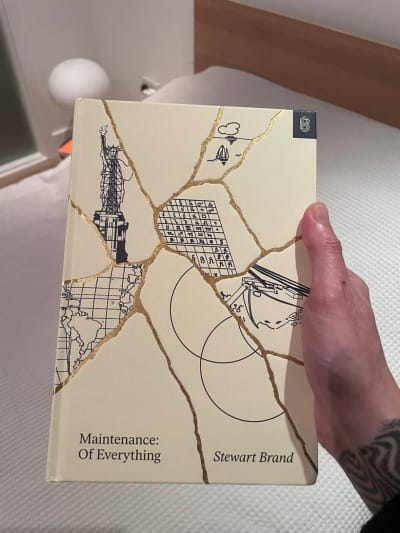
Inside, the frontispiece subtly announces the book’s intentions and understanding of itself, by copping the graphic design and typography of old US Army field manuals. That’s kind of a hoot.
But it’s not great that just about the first thing your eye falls on after that is a quote from open-source software advocate/noted misogynist and racist Eric S. Raymond. In current year, unironically invoking ESR feels greasy and retrograde and gross – not quite as bad as getting some DHH on you, maybe, but not far off, either. It’s a small thing, but dig: not a good small thing.
The book’s high point is reached very quickly thereafter, in a rip-roaring opening section on the Golden Globe Race and the great solo circumnavigators of 1968-1969. Brand’s account of the competition between Robin Knox-Johnston, Bernard Moitessier and the doomed Donald Crowhurst is wonderful, if a trifle Boy’s Own. What’s great about it is that it works on a couple of different levels. It’s fundamentally just heart-pounding fun to read, but it also allows Brand to draw real contrasts between Knox-Johnston’s, Moitessier’s and Crowhurst’s wildly diverging approaches to design and maintenance. (Spoiler alert: it’s not unreasonable to suggest that Crowhurst’s wound up killing him.)
A kind of step-down effect kicks in from this point forward, in which every successive discussion across the balance of the text feels less and less verveful and convincing. There’s an infuriating slackness to the information hierarchy at work in Maintenance. The opening Chapter 1, about the Golden Globe Race, has but a single section, and it is as tight and coherent as the lessons it offers. Chapter 2, which constitutes the whole rest of the volume, is dedicated to “Vehicles (And Weapons).” It sports twelve sections, four numbered “digressions” of significant length, and even a few “detours” from those digressions. This weirdly uneven information design is mirrored in the content, which takes in the well-trod, the interesting but deeply uncomfortable, and the head-scratchingly weak.
Let’s take each of those in order. The ground tamped down most firmly consists of an extended comparison between the design philosophies epitomized by Mikhail Kalashnikov’s AK-47 and Eugene Stoner’s M16 assault rifles, respectively. For anyone interested in industrial design, this is a somewhat overfamiliar topic — so decisively discoursed-upon, indeed, that there is a Wikipedia page dedicated to the contrast. Brand’s retelling has a few unusual flourishes, notably his decision to top-and-tail his account with a discussion centered on two of Catherine Leroy’s photographs of Navy corpsman Vernon Wike, the first taken in Khe Sanh in 1967 and the second weeks before his 1995 death. The trouble, bluntly, is that this material feels like padding. I get that Brand wants Leroy’s photos to help ground what might otherwise be abstract questions of design philosophy in human stakes. But they didn’t really do that for me, nor did they really advance my understanding of the issues in play.
There’s a neat interlude about differing types of corrosion, complete with handy recognition charts. And then follows the deeply uncomfortable bit: a long, laudatory section on the IDF’s improvisational genius in the Yom Kippur War, as contrasted to the ostensibly culturally-determined weaknesses of the Egyptian military.
What makes the section uncomfortable isn’t simply Brand’s rather neutral, red force v blue force narration of the conflict, when one of those forces is the IDF. It’s the frankly retrograde way he frames his analysis of it, which, in just about so many words, pivots on the notion that “shame is the overwhelming concern of the Arab.” The Egyptian Army’s failures may well have been down to a culture of information-hoarding designed to prop up the social status of the knowledgeable party, and in which the class divide between officer ranks and enlisted meant the former could literally not be seen by the latter to get their hands dirty. I’d actually buy that! I’ve worked closely enough with military organizations from cultures where face-saving is paramount to understand the effect that value has on the flow and accuracy of mission-critical information. But if you want to make that assertion in 2026, I think it’s on you to find sources supporting it speaking from within Egyptian culture, and not rely on imperialist accounts not far removed from something T.E. Lawrence might have seen floating around the Arab Bureau in Cairo in 1915. That’s just gross.
There follows a long bit that, no word of a lie, could have been boiled down to “these days I tend to search YouTube for repair instructions.” Even assuming that these things remain true — and there’s good reason to assert that they do not, even stipulating one’s comfort with the implicit ethical regime — I don’t think anybody needs a hardback book to tell you that you can learn how to fix anything from YouTube, and buy all the parts you may need from Amazon.
And then, reader, it gets worse. So much worse. In fact, I wouldn’t have bought the book in the first place had I known about the entire (brief) section that follows. This is devoted to the design “of” Elon Musk, as if Musk had ever designed anything more elaborate than a stealthy excursion to a hair-transplant clinic. Intimately familiar with the concept of pace layering as he is, Brand correctly notes that different parts or aspects of the book will age at different speeds. I strongly suspect that among the passages that will age most poorly are those celebrating the technical qualities of Tesla cars, which cannot be maintained by users in the usual sense of that word, and are increasingly understood by knowledgeable observers to be deathtraps for their drivers and passengers should they for any reason catch fire. (Exploring the particular irony of lauding Musk’s ostensible design genius, in an era when we know his insistence on flush, electronically-actuated handles on Teslas has contributed to the deaths by incineration of multiple victims, is left as an exercise for the reader.)
And then…that’s it. The book kind of just ends, without even so much as a STEWART BRAND WILL RETURN...IN “RUST IS FOREVER.” Maybe this is what was implied by so prominently labeling the book “Part One,” but it’s still abrupt and startling.
§ I’d mentioned the page design. Brand has made much of how he wrote Maintenance as an “open, public book,” on the libertarian-inflected Works In Progress platform, and that users of this platform were able to offer their reflections on his text in real time, as he wrote it. This ostensibly led to some requirement for the printed artifact to incorporate those reflections, in a quasi-Talmudic style. I don’t, personally, think many of the comments that Brand chose to surface on the printed page are all that interesting — with one exception I’ll describe shortly — so I’m not sure that the book really benefits from either the textual or the information-designerly emphasis on their inclusion.
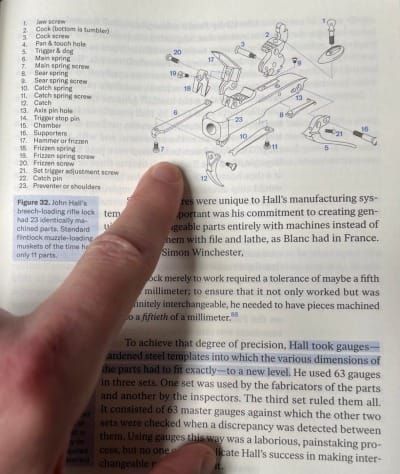
And, as you can see here, if you look closely, that elaborate design is too often undermined by typos or similar. Here, for example, a carefully multicolored exploded diagram, intended to help explain the evolution of interchangeable parts, is missing its figures 4, 14, 15 and 22. I get that they’re not really critical to one’s understanding of the point Brand is making — this is a book about maintenance, happily, and not a repair manual for the M1819 — so maybe this strikes you as a quibble. But why go to the trouble of reproducing such a fussy image, with all its paraphernalia of brightly-colored labels and corresponding key, only to do so badly?
Many of the emendations “suggested by readers” remain tacked on, not fully integrated into the argument. The best example of this can be found in the section on “Six Great Manuals In History” (which is a fantastic idea, and should have been wonderful). Brand includes a footnote indicating that “British novelist Ian MacEwan” read this segment, and said, in essence, “Hmmmm, given their importance, have you thought about maybe including childcare manuals?” And so he just...does that, dropping in a one-sentence quote from the one such manual MacEwan mentions explicitly. If this feels like a box-ticking exercise, that’s because it manifestly is. You don’t for one second get the idea that Stewart Brand thinks Dr Spock is quite as important to the scope of human freedom as, say, the exemplary manual on the construction of Dry Stone Walls he concludes the section with. (More damningly still, what you turn up with a little digging is that Dry Stone Walls itself represents the lifework of a woman, Marianne Hassenstein, who so far as I can tell goes entirely unnamed by Brand.)
And here we arrive, finally, at the elephant in the room. The rage-making thing about this book is that when it’s good, and on the things it’s good on, it is very good indeed, and lots of fun besides. But as a complete production and work of culture, it is disqualified completely by its thorough, fatal lack of attention to those inveterate maintainers known as “women.”
Other than Catherine Leroy, indeed, women are acknowledged in the pages of Maintenance very nearly only on its dedication page. And even then, it’s in a way that isn’t anywhere near as charming as Brand presumably intends:
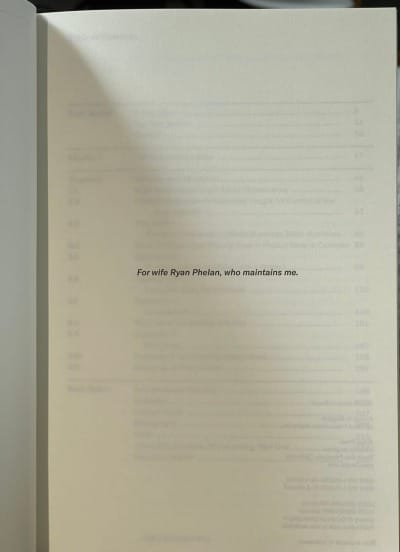
Look: Maintenance is clearly the result of a writer gifted with a lucid, unpretentious prose style, addressing a subject that is simultaneously vitally important, dear to them, and something they’ve thought deeply and carefully about for many, many years. But in the absence of half the species, even all of that together doesn’t add up to a worthwhile book. You simply cannot treat the field involving the durational care of material objects as something exclusively imagined and enacted by men, and limit your discussion of that field to the repair of motorcycles, rifles and cars. Even the Last Whole Earth Catalog of 1971, the edition I discovered in the Miquon library, didn’t quite do that, though it devotes very nearly as much space to Death or even Bargain Buying as it does to Women*.
- * The “Black” section fares still worse in the ‘71 edition: it’s limited to a few paragraphs excerpted from A Rap on Race between Margaret Mead and James Baldwin, and a mailing address for a “Black Reading List” that “looks pretty comprehensive.”
What disqualifies Maintenance isn’t simply its comprehensive erasure of women, though boy howdy that’d be sufficient. It’s also Brand’s insistence on larding the text with the occasional, entirely gratuitous comment revealing who he’s become or always was. The tells are all over the place: consider, for example, a list of “the most highly disciplined maintenance frontiers, which are exotic to most people,” that concludes with “Japanese culture.” He could have simply said “exotic to most of us raised in the West in the twentieth century” or similar, and I would have found it a welcome, even humble acknowledgment of positionality; instead we got what we did, and it feels like an unconscious confession of just who he thinks it is that he’s writing for.
And that speaks to the deeper issue here, which is how the book is weakened by Brand’s narrow definition of “maintenance.” My sense is that he has, for a great many years now, surrounded himself with a tight, highly-accomplished, exclusively male knot of colleagues of roughly similar age – G Dyson, B Eno and K Kelly, e.g., all of whom get namechecked in the book – whose rather groupthinky perception of what’s germane circumscribes his worldview, and whose banalities he therefore accords far too much weight to. And that overweighting has a knock-on effect, which is squeezing out those voices and perspectives that superknot is not capable of perceiving, recognizing, parsing or valuing. As a result, the book feels like it’s sidestepped a whole generation of discourse on the topic, and maybe even two, to its greatest detriment.
This is a shame, both because a Maintenance: that did a better job of centering the ones actually responsible for the care Of Everything would have been an infinitely more interesting and necessary book, and because it’s such a betrayal of that quality of interestedness I’ve always thought of as animating Brand’s work at its (and his) best. It’s hard to conclude anything but that in the pages at hand, we’ve reached the limits of that interest, and that overwhelmingly the works of women remain beyond them.
The broader lesson is somewhat ironic, given that Brand and his acts of knowledge production are traveling through historical time in much the same way as the complex assemblies he’s so interested in. It’s most pointed, too, for those of us of a certain age, who are used to receiving feedback on our ideas from a particular generational cohort. It’s that it’s vital to comprehend, as a matter of maintenance, the ways in which the groupthought of that cohort is tendentially conditioned as the collectivity itself moves downward through time. Another way to say this is that there’s some path dependency involved in insight, and that our later insights are bound to the circumstances in which we first developed their precursors. If we want our ideas to retain relevance — not currency, which can be cheap, but real and enduring relevance — we have to check them against people truly external to our framing assumptions, however long we’ve held them. And this is truest of all when we claim to be speaking to a big, universal topic like the fuzzy-edged domain that takes in maintenance, care, and repair.
For me, that’s the real tragedy here. We need a book shaped a lot like this one, but this is not it. If you expect to come away from Maintenance with the kind of reorienting insights How Buildings Learn dispensed on just about every one of its pages, you’ll be disappointed. And you’ll wonder where all the women went. I cannot in good conscience recommend this book to anyone.
§ Right now I'm reading Hope Without Hope, Matt Broomfield’s book centered on Rojava, in hopes of luring him to Lifepod one of these days; listening to Slint and more Slint; and watching Winter In Sokcho, which made me as uncomfortable as anything in Stewart Brand’s account of the Yom Kippur War.
That’s it for now. As always, I hope that you are well, that you have your feet planted solidly on the good Earth, and that you are taking care of those who need you, taking care of yourself, and letting others take care of you. You have
all my faith,
ag
ldn
This is Dispatch from London No. 161 of Sunday, 12 April 2026, offered to you under the terms of a Peer Production License. You are free to reuse this content, but must acknowledge Adam Greenfield as its author. ◊