Good morning, beloved —
Last week I’d promised/threatened that I’d spend a little more time here explaining the evolution of my thinking about technology and cities, and what issues I’m particularly struggling with as I try to finish my book.
Here’s my torment, in the proverbial nutshell: without for one single second pretending to be an actual intellectual, I’m trying to take a deeper cut at the issues I’m writing about. I want to take them more seriously than I have in the past, to be more nuanced and rigorous in the way I approach them. And one of the things I’m trying to be most rigorous about is who I think we are as citydwellers — and in particular, what capacities we’re able to marshal, what limitations we confront, and what scope of action we enjoy as participant-cocreators of an urban way of life. It seems to me that whatever specific construction I arrive at will have reasonably profound implications for what I’m able to say about cities and urban polities.
What I’m desperate to escape from is the overwhelming gravitational pull of one particular conception of personhood. In far too much of the contemporary thinking about cities, though it’s only very rarely stated so forthrightly, the urban person is still conceived as the traditional liberal subject. This is a natural person with free will and meaningful agency, both atomized and sincere, capable of applying one or more modes of rationality to decisions regarding the choices placed before them. The narcissism of the quantified self movement, for example, is predicated entirely on the existence and salience of this figure; so are normative intellectual projects like the “ideal speech situation” of Jurgen Habermas, or John Rawls’s Theory of Justice. And of course the liberal subject has a whole lot in common with the purportedly rational, utility-maximizing actor at the core of neoclassical economics.
The trouble is that I just don’t find this an accurate or remotely satisfying account, either of the way it is to be human, or the way it feels to live in the presence of others both human and nonhuman. Most importantly, it struggles to acknowledge the reality of power, and structural limitations on choice: not everyone is equally free to act, not everyone is exposed to the same information, not everyone’s in an equivalent position to make use of that information. It fails to acknowledge real limitations on instrumental rationality. And it stumbles profoundly when confronted with our own porosity, or relative openness to our environment and to the others that constitute that environment.
If we are both more and less than this standard account would suggest, it follows that the liberal self can be dethroned in one of two ways: by undermining or overmining it. The more usual thing these days is to undermine it, to argue via reductionist evolutionary psychology that we’re not even the selves we think we are — that consciousness is an artifact and an afterthought, the self a kind of buffer, and the body a mere vehicle for such informational replicators (memetic as well as genetic) that choose to hitch a ride on it. Seen in this light, all the finely-variegated elaborations of human identity are just differentiated reproductive strategies, some more and some less successful.
This line of thought appears to be enjoying a moment. It takes center-stage, for example, in the bleak, chilly and occasionally ridiculous science fiction of Peter Watts, it heavily informs the characterization of True Detective’s Rust Cohle, and from time to time it surfaces elsewhere in pop culture. Whatever its relation to reality, though, this position obviously has thoroughly forbidding implications for any notion of political agency or the organization of selves in self-actualizing polities. Seen in its cold light, we ourselves are nothing but meat. Worse: unbearably pretentious and jumped-up meat, with acute delusions of our own significance. That certainly does dispense with the liberal self, but only at the cost of rendering all human effort as a preconscious array of epigenetic moves of varying efficacy, no more freighted with meaning than a termite mound. The only political positions that even conceivably emerge from any such framing of things are irredeemably ugly.
My understanding of what we are when we walk down the street, slouch in the back seat of a taxi or sit at a restaurant table, by contrast, is an overmining of the liberal self. It draws, oddly enough, on the old concept of a fleet-in-being, an idea about naval force projection in the Age of Sail, circa 1700 (!), first leveraged in the theoretical context by Paul Virilio and later seized upon by Gilles Deleuze and Félix Guattari. (My take on it is simpler than either of theirs.)
As defined in 1690 by Arthur Herbert, First Earl of Torrington, a fleet-in-being is any naval force of significant size that is not currently deployed at sea. Whether moored at its home port or elsewhere, it nevertheless has to be accounted for by any prospective opponent — treated as though it were in fact fully deployed to the maximum theoretical extent of its capability, exerting a field of force across the entire surface of the ocean. You could think of it as a kind of virtual currency, waiting to be spent. Any power planning to engage it in combat is compelled to dedicate some portion of their available assets to defeating or containing any such fleet, even if it never raises so much as a topsail.
After two and a half centuries of cogency, which is not such a bad run for an abstraction, air power rendered all this mostly irrelevant — what was the mighty array of US ships at Pearl Harbor if not a fleet-in-being, and how long was that able to exert force across the Pacific? — but the notion was picked up by Virilio in Speed and Politics, the little semiotext(e) volume you toted around with you all during your last two years of college, hoping someone hot would notice. In Virilio’s hands the fleet-in-being is elaborated in ways that collapse what I feel are some pretty meaningful distinctions, and typically Deleuze and Guattari take it further still, but the vivid figure of a “fleet” as a coiled ball of forces has stayed with me, waiting to be matched with a situation to which it felt applicable.
That’s what we are, our networked selves. Only some small portion of our repertoire of connections is actualized as we sit through inane ads waiting for Mad Max to begin, or gaggle around the bar at the Island Queen, or huddle in an uneasily vertical mass as the 73 bus rounds a sharp corner. And yet we, all of us who are digitally connected, exert force right out to the edge of the network, in every moment. We’re all fleets-in-being.
Try to imagine a lunchtime city center sidewalk that way, fill in the ghostly links that bind us all one to another. Try to imagine the contingent, flickering diagram formed by each person walking down the street in their connection to all the systems that support them — most links inert in any given moment, some selection of them gone hot and live. Try to wrap your head around what it might mean to treat each of them as a vector sum of all their potential connections realized.
Now this is interesting to me; this begins to feel like a more reliable map to the world we inhabit than the liberal subject. But we still have to use that map to navigate. What would it be like to think of urban life, then, as something constituted by ten billion interlocking meshes, most but not all of which have human beings at their core? What forms of self and community could we articulate based on such an understanding of affairs? That’s the book’s final project, and just between us I’m not entirely sure I can muster the powers to make a clean case of it.
But I’m going to try, because I can’t help the trying. Theory is only as good as what it gets you. You deploy the work of one thinker over another because it gets you conceptual purchase on some situation you confront. But then you let it go, you transcend it, you reach for the next toehold or crevice to wedge your foot into. And right now it feels to me like there’s a toehold missing, like the theory we have is inadequate to account for the reality of technologized urbanity in our time, and it’s keeping us from being able to more fully make use of that reality in psychologically and politically creative ways. However unforgivably unhumble it may seem, I want this book to furnish some of that theory, and therefore to do work in the world. I want it to give its readers leverage, and I want them to be able to use it in their struggles, in this city we are inheriting that is posthuman and is posthuman precisely because it is all-too-human.
This, I acknowledge again, is not a modest ambition, and I am always acutely aware I may not be its equal. But we don’t always entirely get to choose our battles, do we?
— In other news, Nurri and I went to see Liturgy the other night at Electrowerx in Islington, not even a bus ride away. GOOD GOD. You can see why honcho Hunter Hunt-Hendrix refers to the genre his project aspires to operate in as “transcendental black metal”: he’s previously written an absurdly pompous manifesto about affirmation, and boy howdy affirmation is what you get. Liturgy live sounds like every possible music, played all at once. It’s the perfect soundtrack for an era whose fundamental problematic is excess rather than scarcity.
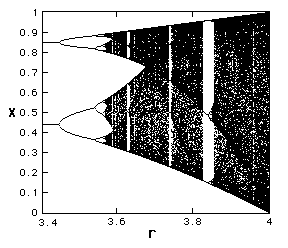
Liturgy’s secret weapon is drummer Greg Fox, with whom Hunt-Hendrix evidently had some kind of falling-out that he’s now wisely chosen to patch up. Fox is so physically optimized for the burst beat that there’s nothing left of him but sinew and wrist. I don’t have the technical musical vocabulary to properly describe what it is that he’s doing with the drums, so I’ll just tell you how it sounds to me: he generates individual beats so intense and fast that they essentially merge into blocks of sound, and from these blocks sculpts a…hyperrhythm, I guess? The actual mechanics of any given Liturgy song wind up hinging on rhythmical structures two orders removed from the individual impacts of drumstick on skin. It sounds thrilling, like pure exultation. (Fox’s technique put me in mind of the diagrams of period-doubling cascades I used to see in books about chaos theory; Nurri said it reminded her of algorithms and Bach.
And on top of this is Hunt-Hendrix spewing a relentless torrent of flat and unweighted Migos-style triplets, which lends everything just the ritualistic affect he’s going for. If there’s a disappointment in all this, it’s that the tips of Fox’s drumsticks as they break the sound barrier are practically the only thing moving onstage — I’ve never seen a band whose music is so impossibly fast stand so still. Like, you remember those stiff robotic postures early Devo would adopt, the better to communicate their total alienation and dehumanization? Liturgy is almost that bad, but in their case I don’t think it’s a conscious pose. Despite their manifest awesomeness in so many other ways, they may well be the most funk-deprived guitar-based ensemble I’ve ever seen live. It’s astonishing.
The opening act was a one-piece called Circuit Des Yeux, the project of a psychically fragile-seeming young woman named Haley Fohr. Fohr brought nothing with her to the stage but a miked and heavily processed acoustic guitar. I found her both deeply annoying and compelling — like, compelling enough that I knew from her first flurry of notes that I’d find it difficult to stop thinking about her performance.
It really was pretty difficult to get around the annoying bits, which were many. (Even the name Circuit Des Yeux is annoying, though if we’re going there I’ll stipulate that calling your act “Liturgy” is also supremely fucking pretentious.) First off, Fohr reaches for a vocal register cord-shreddingly lower than her natural range. At her most controlled, this recalls Antony or Nico — which is high praise in my book — but otherwise it all too often descended into the kind of inchoate doomwail I associate with Diamanda Galas. Now Diamanda Galas may be “important,” but she’s also unlistenable, and doomwailing detached from any obvious referent just feels adolescently emo.
The more troubling thing was Fohr’s steadfast lack of generosity. The only non-lyric comments she uttered in the course of her set were requests to the sound engineer for first “more vocals” and later “more guitar” in her monitor, which seem like reasonable things to ask except that she only performed with vocals and guitar. She never greeted the crowd, never named a song, sang through her hair and never in fact deigned to acknowledge the audience at any point. I get it — you’re young, you’re hurt, you’re armored, you’re preempting rejection by denying any possibility of connection. Ordinarily I find this kind of horseshit unforgivable.
And yet and yet and yet. Strip away the posturing. Strip away the refusal to engage anyone in the crowd in any way. Strip away the High Drama, and there’s still something at the core of Fohr’s music that I haven’t often heard, a kind of integrity and strength that makes it surpassingly interesting to me. I’m inclined both to give her a chance and to keep my eye on her.
— Finally this week: I’ve been reading Mitchell Dean’s exceptionally lucid and helpful Governmentality (2nd edition), which I recommend to you unreservedly as an exegesis and extension of Michel Foucault’s body of thought on the “conduct of conduct.” (Of course my all-time favorite text in the governmentality literature remains “Gee, Officer Krupke,” from West Side Story, but Dean’s volume has immediately established itself as a contender. Call it a close second.)
Until next week, then: be kind to yourself, and take care of the ones around you,
ag
ldn
This is Dispatch from London No. 30 of Sunday, 14 June 2015, offered to you under the terms of a Peer Production License. You are free to reuse this content, but must acknowledge Adam Greenfield as its author. ◊