Good afternoon, beloved -
Since I spoke with you last, Lifehouse has entered the world as an object for people to buy and read and discuss, and I have (just) completed a three-week tour across an American August in promotion of it. So it's something of an understatement to say there's quite a lot going on, intellectually and psychoemotionally, and I'd like to unpack some of that with you, here.
I should first probably say that, in some respects, my previous experience with Radical Technologies set me up for disappointment. It was about a topic, or a set of topics, that a great many people are already interested in, and which (except perhaps for artificial intelligence) do not present readers with an existential challenge; it was easy to categorize, and thus swiftly made its way to the top of the relevant categories on (e.g.) Amazon, where it bore a pleasing little orange "No. 1 Bestseller" tag for quite some time after publication; it appeared prominently in the window of high-traffic, mainstream bookshops like Foyles; and above all it received both a very generous notice and an excerpt in the Guardian. Expecting that all, or even one or two of, these things would be true of Lifehouse, then, guaranteed a few weeks of rough feelings when none of that turned out to be the case this time around.
What I've had to wrap my head around, in short order, are two facts: firstly, that this very different book will have to make its way in the world very differently, and secondly that I will have to cultivate a certain detachment about its fate if I don't want to labor every day under a little stormcloud of dismay. The nutshell account I've come to relay on is that fewer people will find this book, but — on current evidence, anyway — many of those who do find it will take it to heart more intensely than anyone ever did Radical Technologies, generating a very different set of conversations and interlocutors.
A lot of that was manifest in this tour, which kicked off at Elliott Bay Books in Seattle, and continued onto Page Against The Machine in Long Beach, Green Apple's Inner Sunset location in San Francisco, Powell's in Portland, Redbud Books in Bloomington, Indiana, and Iffy Books in Philadelphia before coming to ground at Woodbine in my New York City. Seattle turned out to be the perfect place to enter this process, too, because it allowed me to begin my reimmersion in the American condition with a ferry ride across Puget Sound, followed by three days on semi-rural Vashon Island with my ex Tamara, her husband Matti, their two brilliant, homeschooled teenage boys, and a whole bunch of goats and chickens and whatnot. Those days on Vashon gave me the time and space to recompose and get right with myself before taking up the challenges of being in (and getting across) America in the summer of 2024.
Those challenges began with the fact that the major cities of the West Coast, anyway, were in the week of my arrival undergoing an acute spike in COVID infections, and yet, outside movement spaces, not really masking or doing much of anything else to contain the spread thereof. I'd already accepted that I was going to mask up throughout the tour, despite the fact that virtually nobody in the UK does, both because I really, really don't want to get COVID again and, frankly, because speaking to the topic of collective self-care before audiences primed to activism around these issues without doing so would badly undermine any credibility I might otherwise have earned with them. But the reality of doing so — of being continuously irritated by the strap, of literally struggling to make myself heard through a few millimeters of nonwoven cloth — all that brought me straight back to the way it felt in the worst weeks of lockdown, and it left me to go on with the tour behind a slight return of the creeping biomedical paranoia I contended with whenever I left the house all through that time.
This was compounded by something which I certainly noticed cropping up around the edges of my Seattle experience, but which really kicked me in the teeth during the few days I stayed in downtown Los Angeles: the extraordinarily acute and visible pain bound up in the unimpeded American opioid crisis, and the plain abandonment to it of a huge number of human beings. Maybe I can convey some of the magnitude and intensity of this circumstance to those of you who don't have any experience of it by describing a single scene, indelible to me — a wraithlike, badly decompensating man standing in front of a city bus, blocking it from moving for a solid ten or fifteen minutes, beating his head against its windshield until it and he both were bloodied — and then promising you that this wasn't even the most upsetting thing I saw that day.
Judging from both the interactions I had and the mainstream political chatter of my weeks Stateside, the sense of a crisis of human dignity spiraling out of anyone's control is something ordinary Americans have already learned how not to perceive or think much about during the moments it isn't affecting them directly, which given the intensity and scale of what's playing out in plain view is pretty disturbing in and of itself. But it dovetails perfectly with one of the sharper critiques of the Lifehouse notion anyone offered during the tour, which is that anyone offering contemporary North American cities a space of refuge like the ones I discuss in the book would immediately be overwhelmed by the needs of people suffering from multiple, mutually-reinforcing conditions of a type that make them very challenging to care for.
A framing that began to emerge from these conversations was of an acute need for "chaos care" — but beyond the acknowledgment that this was a need that would fundamentally condition the ability of communities to protect and provide for themselves for the forseeable future, I don't think any of us had any bright ideas as to what effective chaos care might look like in practice. The only tool that seems to be at hand, between where we are now and some unknown horizon, is harm reduction, which is why all of the more movement-y spaces I spoke in distribute Narcan as well as fentanyl testing kits. But even that gesture of solidarity and care has, perhaps inevitably, come under attack, and it remains profoundly unclear to me how any of this might be resolved at all, let alone in a way that preserves any of the values we claim to uphold. It's — yeah, sure, obviously — a fundamental challenge to the concept of a Lifehouse, but way before that it's a challenge to the ability of American society to furnish far too many of its members with even the basic lineaments of a decent existence. (And not just American, either, as anyone paying close attention to the hitherto weak but unmistakeable signals of an emergent opioid crisis in the UK surely understands. Let me tell you: the storm is coming.)
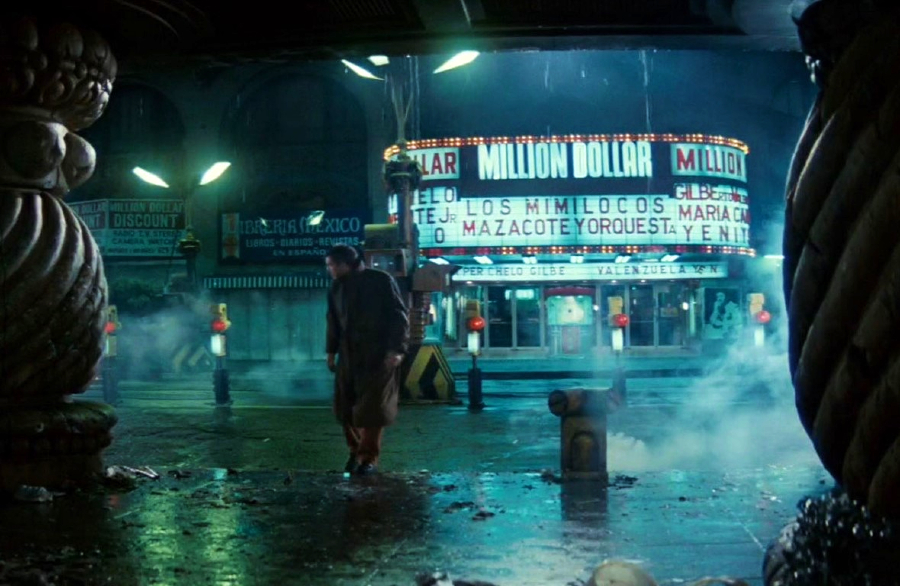
And that was just the background music! I also, dig, dragged my carcass from city to city every two or three days, did my level best to find my feet under me, and got on with the work of presenting this book and the ideas in it to a whole new set of potential readers. You know, I think, that I don't suffer much from extroversion, so you better believe this was in itself A Lot (though it was unquestionably buffered quite considerably by the profound hospitality and consideration I enjoyed in each place, the excitement of meeting IRL a few heads I'd only previously known online, and above all the opportunity to see literally a few dozen people who are beyond dear to me). So I talked Lifehouse, and strolled the trails of Runyon Canyon. I visited the Bradbury Building and the Million Dollar Theater. I saw (and noted the laughably poor fit and finish and generally janky build quality of) my first Cybertruck. I was shown what little there was to show me of Apple's Norman Foster headquarters megastructure. I washed down a Wawa hoagie with a draft Yuengling at Dirty Frank's. I relaxed into the inimitable ambience of the late-night L train, had pierogis from Veselka and fell asleep to the Manhattan lullaby of sirens and horns in the streets below. For three weeks I jammed econo. It all reminded me how much I love these American places, how much I miss them at the most fundamental, molecular level...and, let's be honest, how glad I am to be on the other side of an ocean from them most days.

The one place on this whole trip that was entirely new to me was Bloomington, where I just wouldn't have gone except for the suggestion of some of the folks there who are involved with the Inhabit and Ill Will projects. These overlapping communities paid me one of the most extraordinary compliments of my writing career, by convening a regional gathering of horizontalist, antiauthoritarian, anarchist and closely allied activists from across the Midwest that was in large part anchored in some of the ideas advanced in the book, called Lifehouses Summer Camp. For ten days, something like 150 people came together to live on the land, debate and strategize around the self-organization of radical collective care, and if they stopped short of declaring the Bloomington Commune right then and there it certainly wasn't from lack of desire to do just that. I came away hugely impressed by the infrastructure they've managed to create, excited by the possibilities opened up by that foundation, and maybe just a little bit terrified at the implications of doing this all For Real. It was humbling, and bracing, and inspiring, and it meant more to be than even the kindest review in the Guardian possibly could have. I'll definitely be back for more, when it's time to take this set of conversations further.
And the other great and welcome surprise of this trip was my visit to Woodbine, a "volunteer-run experimental hub in Ridgewood, Queens for developing the practices, skills, and tools needed to build autonomy" that simply didn't exist when I left NYC for good at the tail end of 2013. The Woodbine folks have damn near built themselves a Lifehouse-in-fact, at least in basic outline, and if it still feels in some respects a space apart from the streets in which its nestled, in all the predictable sociodemographic ways, there are important lessons there as to how that situation can be addressed and with a little luck resolved. (I was particularly delighted to see the compact but fully-equipped gym they have onsite, which fulfills some hopes I've been ranting about for years.) It felt hugely apropos to bring my American Lifehouse tour of summer 2024 to an end at Woodbine, where so many of the book's notions of self-sufficiency and distributed capacity are being actualized.
I'll leave my report to you there for now, if that's OK? My heartfelt thanks to Dean Spade, Cory Doctorow, members of the Redbud Collective, Glenn Wallis and Maria Herron for so generously agreeing to be in conversation with me and the book; the folks from Portland Street Medicine and the People's Store PDX for agreeing to participate in the event there; and everyone who put me up, picked me up from a ferry/train/airport, fed me In'N'Out burgers, French Dip sandwiches, margaritas, charcuterie and fresh baguettes, furnished me with cat energy, or otherwise worked behind the scenes to make this possible. I have an extra-double share of gratitude for Michelle Betters at Verso, who called all this into being logistically and organizationally, and served as an invaluable psychic sounding-board throughout the three weeks besides. More shortly. And until then, you have, as ever,
all my faith,
ag
ldn
This is Dispatch from London No. 129 of Tuesday, 20 August 2024, offered to you under the terms of a Peer Production License. You are free to reuse this content, but must acknowledge Adam Greenfield as its author. ◊