Good afternoon, beloved -
I’m writing to you today from Zagreb, in Croatia, where I've come to do the final tranche of fieldwork toward my PhD. Other than a few hours each in Split and Kotor as a tourist, these eight days on the ground constitute my first experience of any of the cities of the former Yugoslavia, and it's been eye-opening in a number of ways.
Fundamentally, I'm here to interview people who've been closely involved with the green-municipalist effort Zagreb je NAŠ ("Zagreb is OURS"), which has held City Hall since the mayoral elections of 2021 as part of the broader Možemo! ("We can!") platform. On paper, I'm interested in evaluating Zagreb as a case study in municipalist practice. One of the things I hold to be true, though, is that a research trip of this sort is bound to be of little value unless it also and at the same time folds in an attempt to apprehend some of the social and psychological transformations that precede, enable, accompany or follow on from the objective change in systems of governance. I guess what I'm really most interested in is the affective and textural stuff that all political science and even most sociology tends to overlook: What does it feel like to live here from day to day? How is that experience different from other places on Earth? Why did municipalism feel like a way of addressing the problems people perceived themselves as confronting, and to what degree does it feel like it's been able to generate responses to those problems once in power? How, if at all, does a municipalist city feel different from a social-democratic or neoliberal or right-populist city, to name only a few of the most obvious alternatives, and what if anything has changed about the things people feel authorized to do and the ways they feel able to be there?
In the end, I'll get my interviews, and with any luck they'll contribute to my coming home with some improved clarity about many of these questions, but I'm willing to bet I won't learn nearly as much from them as I will have from simply walking these streets with friends, paying careful attention to the way ordinary life unfolds in these particular spaces.
For example: I'm not nearly clever or diligent enough to have planned it this way, but I happened to arrive in time for Trnjanski Kresovi, the city's annual antifascist bonfire (and how awesome is that string of words?). There were a number of things that amazed me about the event, not least the fact that a decent chunk of the city's population attends, including virtually all of the figures I'd hoped to interview. By the time my friend Dubravka and I showed up at the site, in the early evening, a robust crowd had already gathered on the bank of the river Sava, buying beer and popcorn before finding a place on the slope they could look down on the five pyres arrayed in a star formation on the floodplain below. The general vibe was neighborly, celebratory, family-friendly — but for the notable density of left-wing t-shirts and folks wearing black, you could be forgiven for mistaking this for July 4th fireworks in a small Midwestern city. Toward sundown, an all-woman drumline took up the familiar beat of "Bella Ciao," the crowd burst into song, and as someone trotted around taking a firebrand to the pyres and the first long tongues of flame leapt into the purpling sky, a moment of something close to pure joy swept over us.
In that moment, after the initial endocrine rush of communal glee had passed, what I felt was deprived. It struck me that these people were living their politics: not endlessly, pointlessly rehashing it, whether from small-institutional stage, rickety pub stool or social-media account, but enacting it. They were reaffirming the value of the sacrifices made by those who had gone before, as well as their living bonds with one another, in an observance that had as much to do with the laughter and the beer and the popcorn and the facepainted kids running around underfoot as it did with anything else. As importantly, they were doing so as a public, in full consciousness that the values they were upholding in and through this aggregate performance were the same as those articulated by the organs of government, because to a surprising degree (and possibly only for the moment) they were the organs of government. And it was obvious that on this rise above the river, a cohort whose members had first encountered one another as young filmmakers, hackers, philosophers and theater people were now, on the other side of a twenty-year effort, perceiving one another as ex-lovers, as the other parties to shared-custody arrangements, as characters whose irritating qualities were so familiar and so long ago assimilated as to become at least partially endearing, but above all as actors in an ensemble collectively wrestling with what it might mean to exercise civic power.
I don't want to candycoat any of this, romanticize it, or make it out to be more or other than it was. Some of what I experienced may indeed have been little more than the characteristic signature of all events that take place in a demographically smallish and physically compact community, somewhat to one side of the main currents of global culture, composed in large part of people who either went abroad and then returned or who never left in the first place. But by the same token, I don't have anything like that in my life, neither the rich nexus of long-term interconnection nor the proximity of such a nexus to actual power, and the fact of that absence landed fairly heavily. The question it left me with was, at best, only very tangentially related to my motivation for being in Zagreb: what can I, as a paradigmatically rootless cosmopolitan now embedded in a polyglot, rapidly changing, only semicoherent neighborhood stretched across the midriff of a sprawling megacity, do to live my politics in this joyous, vividly relational way, and to help others who want similar things from life achieve the same?
I'm not sure I've really managed to express much of the complex, braided psychosomatic condition that traversed me as I stood there on the embankment, sipping from my plastic cup of beer and watching the sparks stream up into the sky, but hopefully you get the broad flavor of it. What I can say for sure is that I'll be bringing home to London something at least as recentering as any insight into municipalist praxis possibly could have been.
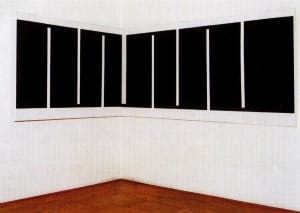
§ In the very best possible way — i.e. by passing a gallery closed for the May Day holiday, seeing a few representative works in the window, and feeling an immediate, mysterious and powerful connection to them without knowing a single thing about their provenance — I've also fallen completely in love here with the work of an artist I'd never heard of before, the Croatian minimalist Julije Knifer. In another of those alignments that I could not possibly have planned better had I tried, it's Knifer's centenary year, and so there just happens to be a synoptic exhibition of his work on at the MSU, the Museum of Contemporary Art, during my time in Zagreb.
Knifer's mature oeuvre consists almost exclusively of bold, intensely inky, obsessive reworkings of the theme of the "meander." I'm drawn to them both as the powerfully graphic artifacts they are, and for everything they suggest about the course of a life, or at least my life: its false starts, blind alleys and recurring recommitments to some principle that's only dimly perceived from within, however obvious it may appear to be to those who see it from a distance. The various Knifer meanders on display at MSU have different ways of exploring this theme, but most all of them hit, and the feeling I experienced in their presence is again something I'm thrilled to be carrying home with me.
I think that's it for now? I apologize for not being more coherent, but it feels like I'm still somewhere in the earlier phases of mulching the events of this field trip. Until I've processed this material more usefully, and we speak again, please know that you have
all my faith,
ag
ldn
This is Dispatch from London No. 127 of Sunday, 5 May 2024, offered to you under the terms of a Peer Production License. You are free to reuse this content, but must acknowledge Adam Greenfield as its author. ◊