Good afternoon, beloved -
Now and then in life — at least, that is, if you're living anything like fully — it's inevitable that you find yourself deeply committed to two viewpoints or ways of being that are in inherent tension with one another, and maybe even outright contradiction. You see people bearing up under the stress of this tension all the time. They're palpably vibrating with the effort it takes to suppress the cognitive dissonance of, say, professing a Christian faith, and at the same time supporting politically a cruel, vainglorious, grasping man whose words and acts could not possibly be less Christlike. Or, somewhat less distressingly, "believing in the environment" in some abstract sense, and also liking to shop for clothes. The varieties of this sort of self-contradiction are very nearly endless: there have got to be at least as many of them as there are human beings. What is rarer, I think, is to attempt some kind of reconciliation between two tenets of contradictory belief that does each of them full justice, and that allows each perspective to coexist with and even inform the other without simply rationalizing away the ways in which they come into conflict.
The Hegelian term for this process, if you'll forgive me for invoking Hegel, is of course aufhebung. This is a word I love, despite the unbearable pomposity of deploying it in an English-language text, because like so many terms in German philosophy it registers so many ideas at once, some of them in themselves contradictory of one another. To achieve the aufhebung of two concepts in tension is to lift them up, to abolish them, to suspend them, and finally to transform them into some third, supervening term. What I'd like to attempt here, briefly, is the aufheben of two ways of being in the world that I happen to be deeply committed to: degrowth, on the one hand, and on the other something I'm calling the New Exuberance.
§ I imagine that one or both of these terms are unfamiliar to you, though you might well know them by different names, or none at all. For most people, I guess, degrowth is more likely to strike a chord of recognition, now that Kohei Saito's books on the subject have broken unexpectedly wide. For those of you who haven't come across Saito, though, it's a way of thinking about production, consumption and exchange inside of the operating limits imposed by our self-sustaining planetary ecosystem. In particular, degrowth questions what is otherwise unquestionable inside the mainstream economic consensus — the growth imperative that furnishes mainstream thought with literally the sole criterion by which it assesses the health of all enterprises, as well as the economies in which they operate — and challenges the notion that there is any necessary relationship between prosperity and the absurd material overspill we associate with late capitalism. If I can put degrowth in a nutshell, it's the idea that prosperity, the experience of abundance, has nothing to do with stuff, and ownership, and the other places most of us are generally accustomed to looking for it, and arises instead from sources which are both much harder to commodify and which present much lower risks to ecosystemic health.
One trouble with this line of argument is that our positive associations with growth and its encouragement run very deep, linguistically, cognitively and socially. So while "degrowth" is a framing that appeals to me tremendously, I'm perfectly aware it's terrible for a rallying cry that's actually supposed to motivate ordinary people. (Advocates seem to be twigging to this as well: pace Saito, the discourse now is more and more often one of "post-growth" or "steady-state" economics. It's probably for the best.) But whatever we call it, the idea seems essential to any kind of inhabitable future. Unimpeded economic growth and, materially, the resource extraction it depends on, simply bring too much pressure to bear on the delicate systems undergirding all Earthly life.
If the extensive growth of an enterprise is the only way in which its success is measured, and the only metric that counts when allocating rewards to its stewards, then all the incentives point in the wrong direction. We're trapped in a positive feedback loop that amplifies precisely the thing that's killing us. There's a cliché expressing this understanding, which we owe in its original formulation to the wildly problematic American naturalist Edward Abbey: that the only thing in nature that grows without limit is cancer. So the project of degrowth, by whatever name you call it, is extraordinarily urgent. Without the slightest exaggeration, the sundering of felt prosperity from ever-increasing production and consumption feels like something we'll have to achieve if anything like high-complexity human society is to survive on this planet. We will have to learn together how to live better with less.
Maybe you agree with this, maybe you don't, but degrowth is a little like the way Phil Dick described reality: it's going to happen one way or another, whether you believe in it or not. The only real question remaining to us is whether degrowth will be consensual, negotiated and managed — which, however improbable, is the outcome I clearly prefer — or nonconsensual and catastrophic. To whatever degree it has a central organizing principle or throughline, then, my work is dedicated to increasing the odds of the former outcome, however I can.
§ So what's the thing this commitment comes into such stark conflict with?
It's something I think of as the New Exuberance, which is the veritably Cambrian explosion of designed forms anyone with an Instagram account can see we're living through. The New Exuberance is born at the convergence of multiple, intersecting trendlines, from the everything, everywhere all at onceness of a culture in which all aesthetics and expressive genres coexist simultaneously, to the massive democratization of design and production capacity, to the combinatorial explosion of more-than-human creativity that is unlocked when computational design tools with very low barriers to entry appear. But the bottom line is this: no longer is what gets made a question of capitalization. More subcultures, more niche communities of taste or interest — more individuals — than ever before get to participate directly in the design and production of items quite literally tailored specifically to their needs and desires.
So let's say you run. Prior to 1971, you ran in whatever sodden wad of leather or canvas your school, team or military unit issued you, because those were the only people who ran. Then Bill Bowerman and Phil Knight come along and design the waffle sole for Steve Prefontaine, the modern running shoe is born, and a whole new lifestyle opens up — along with, NB, the market to serve it. But designing and manufacturing such shoes at scale was capital-intensive, and required the creation of a sprawling and coordinated apparatus; in fact, I don't feel like it's all that great an exaggeration to say that much of late modernity was produced in the effort of figuring out how to assemble running shoes for the lowest possible cost in global-South labor regimes, and then ship them across the ocean cheaply enough that you could still sell them at a healthy margin.
Now fast forward to Current Year. You run. Would you prefer to run in big chunky health-goth shoes? Shoes with uppers of Dyneema, that are barely even there at all? Shoes (ostensibly) co-designed by Special Forces operators to meet the requirements of their craft? "Barefoot" shoes, to signal your irrepressible feral nature and alignment with the discourse of Wildness? Super-cushioned shoes, to buffer the damage you incurred running in barefoot shoes? Take your pick, because everyone and their cousin is making shoes now. When coupled to commoditized outsourced production, the exponential profusion of lifeways and semiotic codes drives almost unlimited consumer choice.
But the degrees of variation that help to define the condition of Exuberance aren't, in the slightest, limited to aesthetic choice. They extend to entirely new categories of things, to evolutionary lineages of manufactured objects that have never been seen in the world before. Consider: when my mother-in-law visited from Korea last week, she brought us as a gift, of all things, a handheld electronic cupping-therapy device. What flashed in my mind the moment she handed it to us was a diagram of the sprawling distributed apparatus that would first need to have been brought into being before anyone could sell such an improbable object at profit. All of the components you'd need to make such a thing — the miniaturized air pump, the power supply, the interface elements — would first not merely need to exist already, but to exist as commodities. Once given that, though, all someone has to do to create something new is identify (or confabulate) a desire, and then bring the available components together in a way that serves it. And that's clearly where we are.
More, we can see parallel processes unfolding just about everywhere we look, from beer to bicycles (or really, to wheeled personal mobility devices of every sort imaginable). Just as the choice of craft beer available has expanded to include everything from grapefruit hazy IPA to abbey-style dubbel to gluten-free Imperial Stout, just as you can get around town on a fixie, a gravel bike, an electric unicycle or one of those ebikes so beefy and overengineered it's three-quarters of the way to being a motorcycle, explosive combinatorial diversity is now the rule across multiple design domains. In important ways, the link between imagining something and holding it in your hand has been short-circuited — with all the explosive consequences that generally attend any other short circuit.
§ But all that merely sets the stage for the true take-off of Exuberance, which ignites when digital design and production are fused and made available to individuals. Maybe it will help me make my point if we consider a single object: this "AI-designed," 3D-printed shoe called the Basilisk.
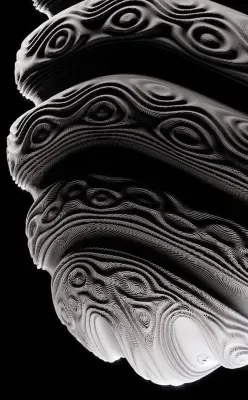
There are a few things in particular that I want you to notice about the Basilisk.
The first is what is distinctive about its material form, which is the fractal pattern of ridges the sole is built up from. This pattern impacts directly on the shoe's claimed performance qualities, and indeed, it's not at all difficult to imagine that a sole produced in this way will sport an exceptional grippiness conventionally-manufactured equivalents would struggle to match. I personally think it's remarkably ugly, but that ugliness isn't really the point. Or, more precisely, the aesthetic qualities I think of as "ugliness" in large part emerge from its performative qualities, and those qualities are reliant on computational design and the additive mode of production. The ugliness is, well, exuberant, and thoroughly intentional.
The second is that, because it is produced by the three-dimensional elaboration of a single material, every shoe can be completely and comprehensively described by a single hashed value. In a very real sense, if you have the hash function, you have the shoe. This is a conversation for a different time, but it's something we ought to take note of.
But the third thing is what makes the Basilisk a stand-in for the New Exuberance and all of the ways it threatens the achievement of a consensual degrowth. This is that it was produced by a single, unaffiliated designer, using generative, procedural tools he needed to seed with little more than a simple textual prompt. It was marketed exclusively (so far as I can tell) through social media, and sold via a networked platform that exists to do just that. Just about the entire apparatus necessary to the manifestation of a new thing in the world has here been dematerialized, become virtual — "angelized," as Marshall McLuhan might have said — and reposed in the hands of a sole individual. Now, that individual happened to be more motivated to explore the edge of current possibility than most of us, but once the process that resulted in the Basilisk becomes generalized, anybody can do what he did. And I have no doubt that many of us will. This mode of production authorizes every impulse toward the exploration of design space, allowing a very large number of us to become designers, and to probe every last lobe of that space available.
And here, finally, is where the conflict I'm wrestling with arises. How on this good green Earth will we ever learn to "live better with less" if the techniques of production available to us are screaming an exponential More?
§ There are certainly those who believe the stakes of total ecosystemic collapse are high enough to justify the withdrawal of democratic choice, and the centralization of decision authority over what gets made. A case in point is ecologist Andreas Malm, who is evidently in all seriousness calling for some analogue of War Communism to see us safely through to the other side of this cindering Anthropocene. But if the starkly rationed existenzminimum implied by any such thing already seems repulsive to the senses, it is utterly impossible to reconcile with a world in which expression, will and desire can, to a first approximation anyway, magick any imagined constellation of atoms into being.
It gets worse. As it happens, in the Basilisk, the weak early signals of a coming Exuberance have found a hopefully momentary but for now entirely characteristic signature aesthetic, and that aesthetic signifies alignment with an accelerationist politics profoundly inimical to the achievement of degrowth. Perhaps because of the valence of the buzzwords deployed in its promotion — the appeal to "AI," most especially — this particular style appeals to a niche and rather bro-ish global subculture of dudes who fetishize algorithmic creation for its own sake, and was first picked up by a content farm catering to that crowd called Parametric Architecture. (For those of us attuned, in a not entirely healthy way, to the inside-baseball currents of design discourse, that name itself signals enthusiasm for the frankly fascist long-term project of that bargain-basement Musko-Thielian, Zaha Hadid Architects' risible Patrik Schumacher.)
And this is the worst possible news. I think it's vital to understand that the Exuberance itself is orthogonal to late capitalism's voracious need for new markets, new shards of identity and new regimes of extension, however happy a circumstance it may be for those who'd try to collapse it to those things. It represents something both inexpressibly joyful and, in the end, irrepressibly upwelling: the achievement of design as a fully expressive medium, and of a mode of production more tightly coupled to human curiosity (and what's more, to the unimpeded curiosity of a great many humans).
It seems to me that one always wants to move with, and not against, any vector of combinatorial creativity so elementally bound up with the production of the new, which is why it feels so critical to me that we sever the New Exuberance from the accelerationist project. I think we want to move with the Exuberance, but do so in a way that allows it to unfold without compromising our collective survival. There's a practical principle here, as well as an ethical one. Any fool trying to stand athwart it yelling "Stop" is bound to wind up, sooner or later, in the position of the last hapless border guard helplessly watching his wards streaming over the Berlin Wall in their thousands.
So. Is there any way to square the circle, any way at all? Could an artifact like the Basilisk shoe, to choose a random example, be produced within a degrowthist or postgrowth production regime? A degrowthist Exuberance is certainly possible in principle — which is to say, sure, it's possible for me to imagine ways in which this sort of thing might have been made inside a circular, resource-recovery economy. But let's be clear that at present, saying it doesn't seem like the likeliest trajectory is a bald understatement. Any such thing is frankly predicated on improbability stacked on improbability: that both fabrication devices and the computational engines on which design relies are powered by renewables, end-to-end; that the feedstock required by the process of fabrication can be produced regeneratively; that whatever portion of that feedstock is bound up in offcuts, failed prototypes and products at the end of their service lifetime can be recovered in some way that is neither markedly energy-intensive, nor poisonous to the environment; and that wherever possible, distribution is a matter of shipping bits not atoms.
If we want to not merely grasp the Exuberance, though, but do so in a way that safe planetary operating limits are not exceeded, that's exactly what we'll have to achieve. It's the only way we can reconcile a liberatory and ecologically respectful politics with the explosive possibilities represented by emergent techniques of design and production. At every step, we need to be asking ourselves how the flows of matter and energy on which that production relies can be made safe for the planet, and for all of us who live upon it. But I think we better figure out how, because I always want to be on the side of ecstatic affirmation, you know? I have that dealers-of-lighting feeling again, with the coming of these emerging production capacities — and if to them I want to offer a mighty Nietzschean YES, I also want that YES to open onto a Spinozan joy, nothing less than an expansion in the possibilities of being. There's just no way we can have any of that if we allow the New Exuberance to be captured by forces ultimately incompatible with a just and equitable future. We certainly do have our work cut out for us.
§ Right now I'm reading Stephanie Wakefield’s brilliant Anthropocene Back Loop: Experimentation In Unsafe Operating Space; listening to Jambinai, the new Senyawa and “the spiritual sound of ecstatic black metal by the band Agriculture”; and watching Alex Garland’s Civil War, which we’ll no doubt discuss at greater length before too long.
More shortly. Until then, take care of yourselves, take care of those around you, and remember to let yourself be taken care of. You have, as ever,
all my faith,
ag
ldn
This is Dispatch from London No. 130 of Thursday, 5 September 2024, offered to you under the terms of a Peer Production License. You are free to reuse this content, but must acknowledge Adam Greenfield as its author. ◊