Good afternoon, beloved —
Amidst all the other sorrows, frictions and frustrations of our lives right now, I understand it if Hong Kong isn't particularly central to your thoughts at the moment. But let's be clear that what's currently taking place there is an act of urbicide, unfolding right before our eyes, and not in particularly slow motion, either. I think of what's happening (or more correctly: what's being done) to Hong Kong as something like the detonation of a neutron bomb, a weapon designed to preserve the physical landscape — not to put too fine a point on it, the real estate — while incinerating all traces of a human population and its culture.
Trust me that this is only barely hyperbole. It's hard to understand the CCP's wholesale replacement of Hong Kong's feisty, contentious, Cantonese-speaking culture as anything but the kind of cleansing that exorcises us when we see the Israeli state attempt it in the West Bank and Gaza. The violence may be nowhere near as kinetic, the damage for the most part done to what Raymond Williams called a "structure of feeling" rather than buildings and bodies, but it's no less real for all of that.
Residents now phone in denunciations of their ideologically-iffy neighbors, and are rewarded for it, in a preview of what life will be like after the social-credit system prevalent on the mainland is stood up in full. Pro-democracy outlets like the Apple Daily find themselves penned in, folded up, harassed out of business. The new national-security law criminalizes assembly, academic research, intellectual inquiry, criticism of the government or the police, simply speaking your mind. Friends whose work, or activism, is no longer tenable flee for safer havens elsewhere in the greater Sinosphere, with even drably authoritarian Singapore offering more scope for freedom of conscience and expression. Dishearteningly, nobody much in the West seems to be paying much attention to any of this, except for a few dutiful wire-service pieces in the papers and perhaps some flickers of outrage on the Christian right. And everyone does their best to tamp down a nervous presentiment that once having digested Hong Kong, an emboldened China won't be satisfied until it has similarly absorbed Taiwan.
I'm not going to pretend that the old Hong Kong was anything like utopia, either before 1997 or in the years since, because that would be both transparently false, and disrespectful to the many that have long struggled to enact the basic tenets of equity and dignity there. Many of the conditions that most enduringly fascinate Western urbanists about the place, from Kowloon Walled City to Chungking Mansions, were generated by circumstances of marginalization, ghettoization and surreal deprivation we would rightly call out were anything even remotely like them to crop up in our own backyards. And it would be hideously mistaken to assume all of the pro-democracy forces are somehow motivated by an abstract commitment to broader participation or economic justice; for all that it may have been on the side of the angels in the present struggle, for example, let's not forget that the Apple Daily was always the plaything of an oligarch, no doubt clearsightedly operating in his own material and pecuniary interest. (In this, perhaps it is not so very different from the Washington Post.) You don't need to stan Chow Yun-Fat to understand that the city was always a mire of corruption and grinding exploitation, and for all too many a vale of tears. But for all its many, many faults, the brash and brazen Hong Kong of old was infinitely preferable to the conformist, politically quiescent, Mandarinized monoculture long planned and, so far, successfully installed by the CCP.
The trouble is that the CCP manifestly does not give a fuck what anyone else thinks, and — as still more distressingly, where the genocide of the Uyghurs in the Chinese northwest is concerned — will do just as it likes until and unless it chooses for its own reasons to do otherwise. Other than its own changing priorities, there currently seems to be no force on Earth capable of stopping Zhongnanhai from exerting its will on Hong Kong, and it's hard to see how the process of subsumption that's been unleashed there can be prevented from running to completion. Consider that in the 1940s, it took the consolidated might of Russia, China, the US and the British Empire to contain the Axis powers, attrit their capacity to prosecute war, and ultimately prevent them from fulfilling their ambitions; in our world, there is no such array of forces, nothing large enough to use as a lever and no fulcrum to hand whatsoever. Armed conflict is inconceivable, and therefore unavailable as sanction or disincentive; the global economy is far too intimately intertwined for China to be marginalized the way, say, apartheid South Africa was; and in any event, even were there a third-party external audience whose shifting sentiments might decide the issue, the West long ago squandered any claim it might make to moral high ground. Indeed there is a terribly real sense in which China is already the protagonist of the human drama, and all the rest of us merely NPCs nattering ineffectually at the edges of its story.
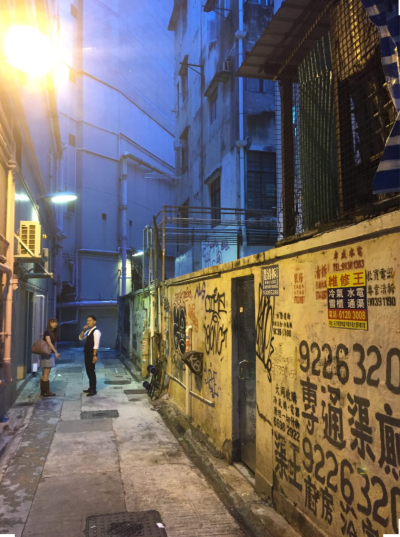
Given all this, there doesn't seem to be anything standing in the way of the destruction of the Hong Kong I knew, and I can't even begin to imagine how one would go about mourning a loss of that shape and size. Every city has some claim to uniqueness, of course. But Hong Kong is more itself than just about anywhere else I've ever been. It's that rarest of things, a truly distinct place on planet Earth, from the Mid-Levels Escalators to midnight crossings on the Star Ferry. There's nothing and nowhere else quite like it — nowhere quite as seedy, as romantic, as obvious, as electric, or as dizzyingly dense with texture and experience. If much of that unique identity was born at the interface between empires, generated precisely by their tectonic grinding against one another, that sense of living on the threshold or seam between very different ways of being in the world is precisely what the CCP seems hellbent on effacing and overwriting.
Just as with the outflux of (largely but by no means exclusively Jewish) talent from Nazi Germany in the run up to World War II, China’s heavy-handed suppression ought to produce some interesting second-order flows. What with almost three million Hong Kongers bearers of a British National Overseas passport, and therefore immediately eligible for residence in the UK, I can certainly imagine the complexion of London in particular evolving fairly rapidly — even a tenth of that would be enough to subtly inflect the local culture, with all kinds of unpredictable but undoubtedly generative consequences. (Who knows, maybe we'll finally get some decent dim sum.) But as delightful a prospect as that is, and a deliciously ironic riposte to a Brexit Britain that thought it could just pull up the drawbridges and withdraw into itself, that's awfully paltry compensation for the destruction of a whole way of life. I despair at the undoing of the Hong Kong I’ve always thought of as irrepressible, and in the wake of its passing, a world become just that little bit more airless and self-similar.
I'm still reading Russell's History of Western Philosophy; this week I've also been listening to Divide and Dissolve and watching The Handmaid’s Tale.
Until next time: please remember to take care of yourself and those who need you, and to let yourself be taken care of. You have, as ever,
all my faith,
ag
ldn
This is Dispatch from London No. 110 of Sunday, 27 June 2021, offered to you under the terms of a Peer Production License. You are free to reuse this content, but must acknowledge Adam Greenfield as its author. ◊