Good afternoon, beloved —
Having notched an unprecedented 548 consecutive nights in the same city, I'm finally heading out of town this Thursday morning, for a gentle, self-prescribed microdose of travel. After two and a half (no doubt anxiety-wracked) hours on a train and a swift hovercraft flight across the Solent, the plan is to spend a few days on my own walking around the Isle of Wight. I've mapped out a relatively undemanding itinerary on the coastal paths, calibrated mostly to get my legs back under me, and with any luck, by the time I make for home I'll have my head screwed on right.
Given that I've spent so very long in one place, it's unsurprising that I'm looking forward to my excursion with a froth of complicated emotions, of which the basenote is confessedly a barely suppressed glee at the simple prospect of hanging my hammock and sleeping under the (many) stars somewhere I've never before set foot. There's a great deal to be said for staying in one place long enough to see the world's slower cycles unfold, certainly, and for cultivating the deeper rhythms my frenetic lifestyle had generally interfered with over the past twenty years. But it's been a few months now since I really started to feel cut off at the knees, and whatever adventures-close-to-home I've managed to gin up under the constraints of pandemic and lockdown just haven't been doing it for me of late. I need to Get Out.
Some of that perceived need surely has to do with the sensory richness and unpredictability I've felt deprived of in the near vicinity of home, or more precisely these two things in combination. It's hard to articulate exactly what I'm looking for, actually, or what it is I feel the acute lack of: what is the city I live in, after all, but a continuously unfolding, richly-textured tapestry of unfamiliar environments, available always and at any hour for the cost of a bike ride? And but for my abortive, rapidly-abandoned plan to paddle across the Solent in a packraft, it wouldn't appear that there's anything wilder to be found on the Isle of Wight than I might encounter in Epping Forest, right there at the end of the Overground line no more than forty minutes from my front door. Maybe it's simply the promise of a new horizon.
This inability to describe just exactly what it is I'm craving puts me in mind of a conversation I had with my friend Usman not too long ago, in the course of a ramble around Hampstead Heath. I was describing my frustration at not being able to account for anything we'd experienced in the preceding few hours in anything but the vaguest of impoverished, ultra-low-resolution, almost childlike terms: "We walked down this path, saw these birds sitting in that stand of trees," and so on. And following from this, whatever it is that I experience when I walk in the woods, that day or any day, it's certainly nothing like the experience of someone who knows what they're looking at. Language, in other words, gives you eyes to see the world.
Consider this extraordinary, rigorous description of an agrimony plant I came across in one of those white-guy-walks-the-world-in-wide-eyed-wonder tomes I'm so fond of, Robert MacFarlane's The Old Ways. It's originally from a Victorian guidebook called Flowers of the Field, by one Reverend C.J. Johns, and I find it exemplary of the pleasures of the mode of expression I always think of as the "technical-lyrical":
Herbs with stipulate, pinnate, serrate leaves and terminal bracteate spike-like racemes of small yellow flowers; sepals 5, imbricate, persistent...carpels 2, 1-ovuled, within the spinous calyx-tube; fruit of 1 or 2 achenes.
Here, for reference, is what agrimony looks like:
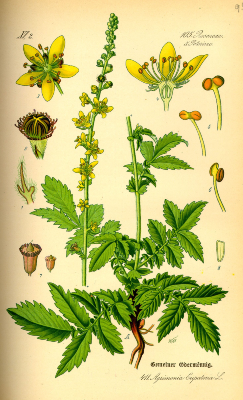
I suspect that someone with a just slightly more fully developed visual imagination than I would be perfectly capable of retrieving a mental image pretty close to everything depicted on this plate from the verbal description alone. That's how careful the accounting of elements is, here, how finely-grained the analysis of parts and wholes and their relation to one another.
It seems to me that analysis precedes rigorously descriptive language — for the need for itemization, definition, classification and enumeration of parts would appear to proceed in the first place from empirical inspection of the world and its contents — but that once you come into the possession of that language, it thereafter structures and orders how you are able to see, and maybe even what you are able to see, in a weakly Sapir-Whorfian way.
Now imagine having access to language of that precision as part of your fundamental equipment as a walker. (Or perhaps you don't have to imagine, because you already do.) You're not just yomping around the terrain. What is unknown to you of the flora, fauna and geological formations you encounter can at least be characterized. You can read the land differently, more rapidly orient yourself to its contours and gradients. You can better understand both the processes that generated it and those that inhabit it. You move through, and participate in, an incomparably richer world.
Here's where the abyss beckons — this is me writing, you knew there was an abyss coming — because of course, every domain of human endeavor has a specialized language just this rich. That's what jargon is, moreso than the semantically barren buzzword salad we usually think of when we hear the word. (And perhaps we can take this slippage of meaning as an indicator that “jargon” is itself part of the technical jargon of linguists.) The richness is there all around us, profound and universal, but we generally can neither perceive it in its full complexity nor convey any experience of it we do have to others, because we lack the vocabulary that would allow us to do so.
And this brings me full circle, back to the worries I was having about participatory democracy and the distribution of cognitive capacity a few dispatches back. However are we to make reasonable collective decisions about our allocations of time, energy and resource in the world, if we don't see the world in any detail? Though on some other level I know it can never be anything more than a finger pointing at the Moon, consider this, ultimately, a way of valuing the equipment of perception with language. Whether it derives, in our credential-happy, professionalized epoch, from formal training, or the high-amateur fussiness of a Victorian botanist, it feels like a step on the way toward more fully dwelling in the world, and being a wiser steward of it as well.
§ I'm still reading Russell's History of Western Philosophy, though well and truly into the homestretch now; listening to new Boris, Botanist, etc.; and, for my sins, watching The Man In The High Castle, avoided lo these past six years on the well-founded suspicion that it could only fail to live up to its source material, probably my single favorite PKD book. If you should happen to be in London, you might want to check out War Inna Babylon, Forensic Architecture's inquiry into the Mark Duggan case and, more broadly, police violence brought to bear on the Black community in the UK, at the ICA through September 26th.
Until next time: please remember to take care of yourself and those who need you, and to let yourself be taken care of. You have, as ever,
all my faith,
ag
ldn
This is Dispatch from London No. 112 of Sunday, 29 August 2021, offered to you under the terms of a Peer Production License. You are free to reuse this content, but must acknowledge Adam Greenfield as its author. ◊