Good afternoon, beloved —
At the moment, I’m reading a not-very-good but not entirely uninteresting book, George Monbiot’s Feral. Despite my general resistance to Monbiot, I was drawn in by a gorgeous cover, and the promise that he’d offer a nuanced and interestingly different take on rewilding. A third of the way in, it’s unquestionably delivered some value — though perhaps not in any of the ways I’d envisioned.
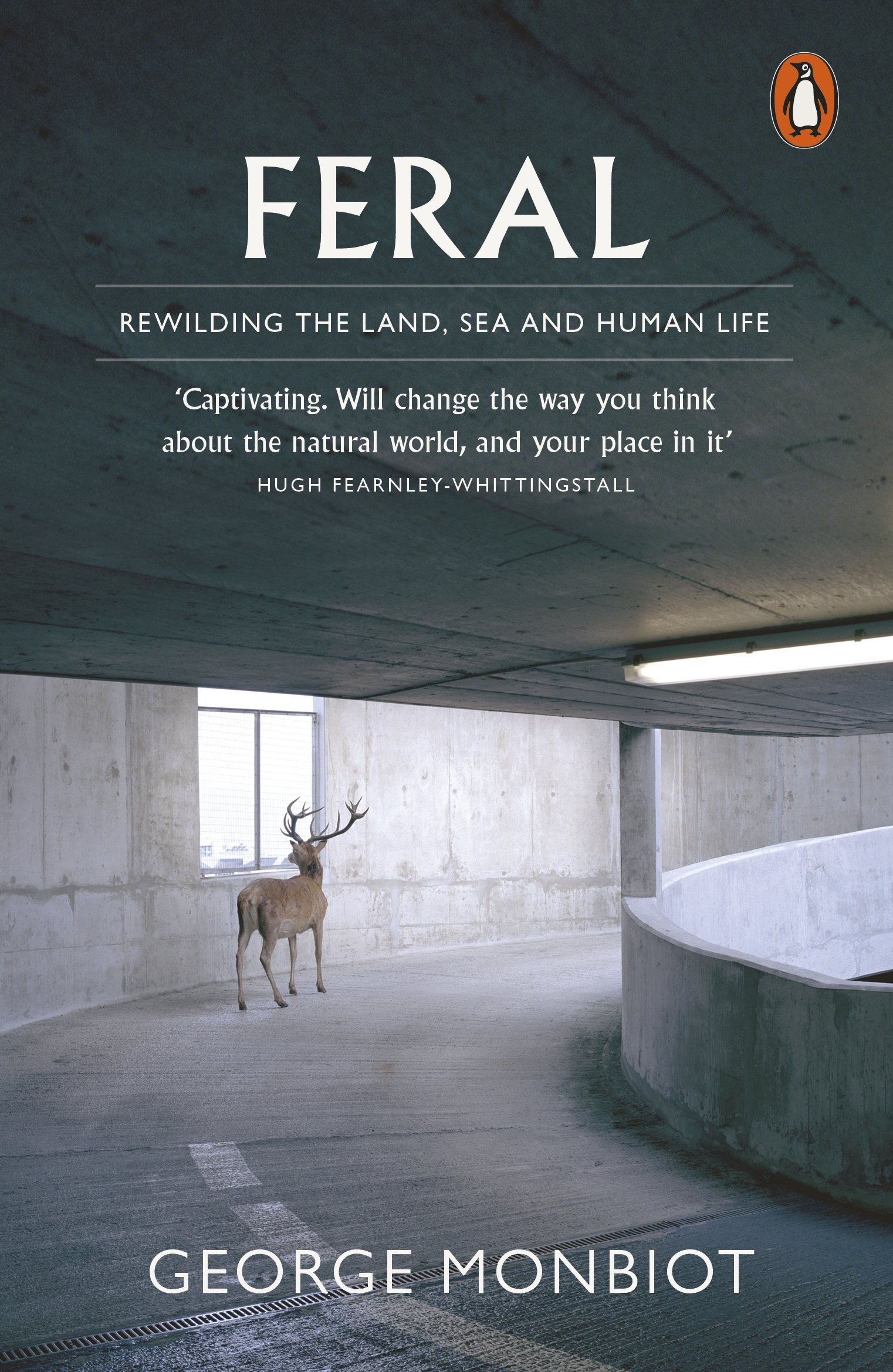
Let’s get the reasons for that resistance out of the way. George Monbiot is exactly the kind of writer I worry most about being: worthy, hard to disagree with on many if not most substantive points...and profoundly irritating. I generally can’t even get through his hectoring, choir-preachy articles in the Graun, so it was something of a surprise that I found myself picking up a whole book by him.
What was I hoping for? In a nutshell, what I most wanted was for Feral to fuse an intellectually serious and historically informed restatement of the core ideas of Go Wild — a book I adore, but which is admittedly but the merest half-notch beyond Oprah-tier pop-psychological crap — with some grounded thinking about what it might mean to live on what Eugene Thacker calls “the Earth,” i.e. the implacable world-in-itself as opposed to the world-for-us. And in its self-indulgent and meandering way, that does seem to be what Feral is setting itself up to do. It’s taking Monbiot time to build up to what feels like his central thesis, in a way my own esteemed editor would never, ever let me get away with, but at least in the elements of it that have emerged so far, that thesis is intriguing.
This is purely my restatement of it, but here's what I think he’s getting at: rewilding, at least as envisioned in the body of rhetoric around the topic that has become conventional, is a futile and even a counterproductive project, on at least three levels.
- Firstly, it’s a fool’s errand. Once the delicate web of interspecies (indeed, interbiogeochemical) flows that constitutes an evolved organic biome is sundered — its participants extinguished or set to flight, its newly-available niches filled by just-arrived volunteers, its constituent cycles of matter and energy rerouted through new couplings — its “restoration” is impossible, even in principle. Attempts to somehow rewind the living landscape to the status quo ante of some imagined time-before will only result, at best, in pastiche.
- Secondly, it quite literally fails to account for the facts on the ground, primarily as those facts are made manifest in the presence of “invasive” species. For better or worse, that presence is an accomplished fact, and must somehow be woven into our conception of the natural if that conception is to have any relevance or puissance.
- And thirdly, that as I'’e so often discussed in dispatches, the peculiar concern for the “preëxisting organic wholeness” of an ecosystem displayed by so many rewilding enthusiasts often conceals/reveals that descent into blood-and-soil nationalism which, in these Isles, seem to have so badly afflicted Paul Kingsnorth and others among his fellow travelers of the Deep Albion current. (How bitterly ironic to see Kingsnorth now decrying “eco-fascism” from the pages of the vile, oligarch-funded repository of reactionary thought Unherd. Even the name of the journal is a lie twice over.)
Monbiot clearly thinks we can do differently, and better. As I read him so far (and again, by page 90 he hasn't yet quite come out and said this in so many words, so I could be mistaken), he's arguing for a “rewilding” of ourselves and much of our environment that could more accurately be described as simply a wilding. That’s what "feral" means, after all: we generally use the word to denote not the born free, but a once-domesticated individual returned, forcibly or otherwise, to a state of ostensive nature. Let it come down — admixture, miscegenation, hybridity, “corruption” and all. Let it all come down, let time take its course, and let that be the new wild. This would appear to be a view of the natural world that draws more from Annihilation’s Shimmer than it does Emerson or Thoreau.
That’s interesting, right? If in its remaining hundred and eighty-odd pages it makes good on even a part of the remaining ambitions I hold for it, it'll make a solid addition to the bookshelf. But in the end, that’s not why I’m happy I took a flutter on Feral. The real reason comes on page 66, in a passage that serves as something of a preamble to Monbiot's account of the Cambrian Mountains of Wales, a plateau that has apparently been overgrazed by introduced sheep since the late Bronze Age, and as a result systematically rendered into the distinctively desolate environment he finds there today:
It is seen as disloyal, especially in this patriotic nation, to talk the landscape down. Some people say they find it beautiful. The Cambrian Mountain Society celebrates its emptiness. It describes the region as a “largely unspoiled landscape,” and approvingly quotes the author Graham Uney, who claims “there is nothing in Wales to compare to the wilderness and sense of utter solitude that surrounds these vast empty moorlands.” To which I say, thank God. What he extols as wild, I see as bleak and broken. To me these treeless, mown mountains look like the set of a post-apocalypse film...Their emptiness appalls me.
I could barely get to the end of that paragraph so eager was I to start planning a trip there. For all that he obviously wants to portray it as something like a pre-industrial sacrifice zone, a perdurable monument to human shortsightedness, foolishness and lack of ecological nous, I found his description of the “green desert of Wales” utterly enthralling. In these words, and in the comparably lunar images I've found online, it calls to me as no British landscape has since I first started planning my two-day traverse of Dartmoor three years ago now — a call that’s only made more irresistible by reading the several accounts of travelers who report encountering no other human soul in multiday traverses of the region. Now I know where I’m going to do my next long solo walk, just as soon as the weather conditions are safe. This gift alone is worth Feral’s purchase price.
There is one complication, however. With nary a human settlement to be found for dozens of miles in any direction, I'll no doubt be compelled to source water from the land in the course of any serious walk. That in itself isn’t really a problem. It's something all backcountry hikers manage, once they've gotten over whatever squeamishness they may have carried about drawing their drinking water from a place sheepshit and worse has surely washed into. You learn to trust your filtration system, and the one I carry in my pack, the MSR Trailshot, is brilliant. The trouble is that there's evidently been a fair amount of lead mining in the Cambrian Mountains over the centuries, meaning a strong likelihood that whatever freshwater I do find there will have been contaminated by runoff from mine tailings, and for all its wonderful qualities the Trailshot simply isn’t up to filtering heavy metals. So it looks like I'm going to have to up my water-filtration game. I've just ordered the Grayl Ultrapress, which is rated for everything the Cambrian Mountains can throw at it and then some, and will let you know how I get on with it.
Now comes the process of ordering the Ordnance Survey Explorer maps, obsessively poring over them, and planning a route suitable for my level of expertise and equipment. (As any map geek knows, this is half the fun, as well as a critical part of imagining the land and its potential hazards before setting out.) With any luck at all, there will be a three-four day window later on this spring in which the gods of weather and travel agree to let me proceed, I’ll spend those days feralizing myself, and come back to our London well and truly rewilded. (By all means, though, do let me know in the meantime if you should happen to have any insight into this terrain and what I might find there.)
As for Monbiot, I'll do him the courtesy of finishing the book, out of gratitude for hipping me to the Cambrian Mountains if for no other reason. Just as with most of his Guardian pieces, though, what I suspect I’ll wind up feeling at the end of it is both that he’s quite correct in what he argues, and that it won’t matter in the slightest to the course of human events. Maybe, in a sense, he’ll even have the last laugh, as I’m reasonably certain the land will rewild itself much as he describes, just about everywhere. I just don’t think very many of us will be around to see it.
§ Beyond the Monbiot, I just finished reading Marcia Bjornerud’s splendid Timefulness; I’m listening to newish stuff from Dead Space Chamber Music, Wardruna, MMMD, the astonishing Senwaya and the wonderful Big Joanie; and watching Sunshine (a far better film than I’d remembered for fully two-thirds of its running time, fatally hobbled by an absurd third-act contrivance) and, perhaps inevitably, Toast of Tinseltown.
Until next time: please do remember to take care of yourself and those who need you, and to let yourself be taken care of. You have, as ever,
all my faith,
ag
ldn
This is Dispatch from London No. 116 of Sunday, 30 January 2022, offered to you under the terms of a Peer Production License. You are free to reuse this content, but must acknowledge Adam Greenfield as its author. ◊