Good evening, beloved -
Without going into any particular detail about it, I don't mind telling you that things have been fairly grim around here lately — obviously on the global front, but also to an unusual degree within these four walls as well. Over the past two months or so, we've had to shoulder a few losses that have hurt terribly, and this in addition to all the griefs and worries we share with everyone else. The experience has compelled the both of us to dig deep, to be particularly conscious and intentional about reestablishing our fundamental connection to the things that lend us strength.
Another way of putting this: when everything feels like it's been broken in such a way that it cannot possibly come good again in our lifetimes, it's more essential than ever to articulate the ways in which the makings of a better, kinder and more decent world remain within reach. That's why, instead of the two longer posts I've been working on, what I'd like to share with you today is the following: the first in what I hope will be a series of entries thematically inspired by my 2014 blog post on the Minimum Viable Utopia. It's meant very much as a reminder (to myself most of all, as well as anyone else who'd find it helpful) that there remain a great many worthwhile collective goals we can meaningfully work toward, and toward which we may live to see genuine progress.
The gist of that 2014 post, however politically and intellectually underdeveloped it may have been, was that many of the material and social components of a lighter, more convivial and more responsible way of living together upon the Earth are already present at hand, and seemingly require very little more than this insight itself before we can begin assembling them in ways that generate lasting meaning and value for us. Some of these elements, indeed, are already in our grasp, and need only to be recognized for what they are.
The element of a better world I want to talk about today is just such a thing. It's our local GP surgery, the clinic through which we access by far the greater part of the free-at-point-of-delivery healthcare services available to us on the NHS. Over the past decade and a half of imposed austerity, we discuss the NHS almost exclusively in the context of the degree to which it's been reduced to a shadow of what it was and should still be, and our local surgery has by no means been able to escape the circumstances that imperil the whole system's ability to function. But considered against the American, Finnish and Japanese healthcare systems I've come to know all too well, my experience of it has been so powerfully affirmative that my only wish is that everyone could avail themselves of a facility like this.
Our local GP surgery is in a repurposed Victorian rowhouse on a sidestreet, a six-minute walk from our front door. But for the sign identifying it and the biosample-collection bin next to the front door, it looks and feels and even smells very much like the terraced housing that surrounds it on all sides. The receptionist remembers you from your last visit. More by necessity than design, the waiting area is scaled such that the other patients arrayed around it — neighbors all, by definition — favor you with just the right amount of civil inattention. There are hardwood floors and a big bay window and, most wonderfully of all, a big chonky cat named Otis, who occasionally wanders in from the house next door and is only rarely shoo'd out again. (Hello Otis.) Once you're into the examination rooms, of course, you're into the sterile, generically clinical world of technical carts, sharps containers and privacy curtains, but even there the coldness is buffered by the old fireplace mantles and odd little touches that remind you that this was once a place that people called home.
I cannot imagine a place I'd rather be seen when I am unwell. Compared, again, to the impersonal, institutional, harshly fluorescent places in which one is generally compelled to seek care by the other healthcare systems my body has known, it feels a lot like utopia to me. And yet this is where I actually go at those irreducibly scary and generally physically uncomfortable moments when I'm dealing with some ailment or another. In fact, it reminds me a lot of that picture I've spoken about so often, and which you may well have seen me share with you before: the one on page 404 of A Pattern Language, illustrating the pattern that Alexander and his co-authors call SMALL SERVICES WITHOUT RED TAPE:
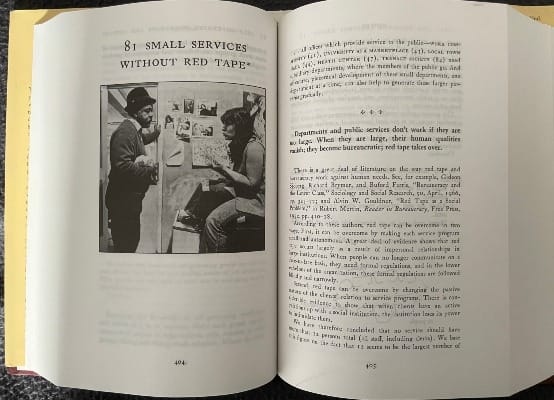
Sometimes a single image conveys a whole lifeworld, right? What is shown in this image is almost certainly a local government drop-in center in Berkeley or Oakland of the early 1970s, the kind of place where citizens might go to seek help with employment, adult education or mental health. There clearly isn't a whole lot of bureaucratic structure being imposed here — certainly not of the do-not-fold-spindle-or-mutilate form so closely associated with early state data-processing techniques. But what is crucial about this picture above all is that it is difficult to discern which of these individuals is the client and which is the service provider. The picture surely offers some clues, in its subjects' body language and their arrangement in the space of the room, and unconscious bias on the viewer’s part may fill in the rest. But really it is impossible to know for sure on the evidence visible before you. To a very significant degree, this is a world of human beings engaged in weaving between them a form of collective and mutual care.
OK, sure: that's not exactly our GP surgery. The NHS remains a bureaucracy par excellence, for starters, and if anything I'd actually prefer for it to be a little bit more structured and consistent in its information-handling practices: except for other British institutions, I've never encountered an organization that manages to lose, misplace or never generate quite so many pieces of literally life-critical documentation. Behind the humane interface, the institutional machinery of the NHS is inattentive to detail, unaccountable, pennywise/pound-foolish, one-size-fits-none, and simply incompetent, far more often than is remotely justifiable, and only a little of that perceptibly has to do with the straitened circumstances of austerity. But the warmth, the informality, the approachably human scale of that interface, the way I can walk in off the street and request an appointment outside of the formal (and broken) protocol set aside for doing so, the way the woman who draws my blood remembers to ask after my partner — in other words, the sense of primary local healthcare provision as a SMALL SERVICE WITHOUT RED TAPE — is everything. And it's a real thing that everyone who lives around here gets to enjoy, whether wealthy or impoverished or somewhere in between.
Could the surgery and its service offerings be made better? Sure it could. But the ways in which they could be improved are mostly a matter of what we might call process design. Relatively few of them have to do with expensive new physical plant, facilities or equipment. And here's the bit that commends it to me, as this first entry in a series on the makings of a Minimum Viable Utopia for our weary, feary times: across a broad span of desirable societies, whether your preferred flavor is anarchafeminist or municipalist or large-scale welfare statist (in either social-democratic or democratic socialist varieties), it's hard to imagine that an effective local healthcare clinic would look or feel much different than the one my neighbors and I already get to avail ourselves of.
We may wish to enhance the surgery's life-affirming qualities, and slowly prune back the ways in which it's exposed to unaccountable, impersonal, capacity-sapping processes. We may wish to help other neighborhoods develop the same kind of provisions. But we don't need to dream the ideal local healthcare service center into being. Something shockingly close to it already exists. What we need to do is defend it.
Other than proposing that there are a great many other things already in our grasp that constitute the makings of a world worth fighting for, if only we learn to see them that way, I'll leave things there for now. But you can expect this to be a theme I'll return to, as often as I possibly can. Every time I think and write along these lines, and take in the thoughts you offer in response, it reminds me that there's a world beyond the one mired in greed and fear and popeyed rage that confronts us whenever we glance at the news — reminds me, and begins to map the road we might take to get there together.
§ Right now I'm reading H is for Hawk, having just finished Blood Meridian (about which all I can presently say is "fuck me, what a piece of writing"); listening to Arvo Pärt and some more Arvo Pärt, always a steadfast companion in sorrow; and watching The Outrun: oof.
That's about it for now. As always, I hope that you are well, that you have your feet planted solidly on the good Earth, and that you are taking care of those who need you, taking care of yourself, and letting others take care of you. You have
all my faith,
ag
ldn
This is Dispatch from London No. 138 of Sunday, 9 March 2025, offered to you under the terms of a Peer Production License. You are free to reuse this content, but must acknowledge Adam Greenfield as its author. ◊