Good morning, beloved -
And I do mean “morning”: we’re only a few days back from Seoul, and the jetlag had me up just past two, so implacably that there was nothing for it but to get up, make myself some coffee and start the day.
There is an upside, though. The world is impossibly still and quiet at this hour, the streets haunted by their own monolithic silence, and that makes good conditions for writing.
I thought I’d take this opportunity, then, to write up some thoughts I had during our time in Korea, while sitting in a wonderful little café/performance venue called Mu, in the backstreets of Sangsu-dong. The thoughts were, broadly, about the gaps between what it is I want to do in this life, what I’ve actually been able to accomplish, and what I have a meaningful prospect of achieving in whatever time on Earth I have remaining to me. In other words, they were about failure.
Here I want to consider failure unsentimentally — in a way that’s non-judgmental and non-self-accusatory, to be sure, but also doesn’t simply valorize the experience in the way entrepreneurial, Silicon Valley culture does, as merely the necessary prologue to some greater triumph. This means thinking, in a semi-structured way, about where it is I perceive some lack or shortfall.
I don’t think there’s any better way to get at this question than by considering what “success” would look like, in the domains of practice and cultural production I’m most interested in. What I’m going to do in the rest of this dispatch is identify some small-scale cultural projects I profoundly admire, and ask of each one of them: in what dimension did they achieve something I would have liked to, and for whatever reason haven’t (yet) been able to?
As recently as a few years ago, I might have been jealous of these projects, or more properly of their creators. Perceived lack so often feels like that, doesn’t it? You want, and want gnawingly, what other people seem to have, on the implicit theory that they’re living a life you believe circumstances have somehow conspired to deny you. I can’t promise that things might not feel that way again at some point in the future, but that’s not the place I’m coming from at this very moment. I’m not comparing anyone else’s life to my own here, except to see if we can’t identify where and how the choices made by certain cultural actors allowed them to bring forth offerings that in some way run parallel to things I would like to make.
I want to be super-clear that most often what I admire about these projects is not their content, which is presumably what generally draws people to them, but rather something hard to pin down about their allometry: something in the shape of them, in the way they meet the world. As we’ll see, that often has something to do with community. The cultural production efforts I’m going to briefly consider in what follows — those of Craig Mod, Ignota Books, Studio D Radiodurans, Merveilles and LOM — are necessarily highly specific in the way they signify for me, and they may well not impress you at all, either individually or all together. But my guess is that you’ll be able to think of your own examples, and that it might just be a worthwhile exercise for you to ask the same questions of them that I’m about to put to these.
§ I first met Craig Mod in Tokyo in 2002, when he interviewed me for a magazine aimed at the city’s expat community, and have been consistently amazed by the trajectory his life has described since. This has never been truer than as regards the shape his offering has taken over the past few years, and in particular the way he’s set up an innovative membership program to sustain him in his practice of cultural production, which in large part consists of going for long walks through backroads Japan, and documenting them with pen and camera.
Again, what most resonates with me about his project isn’t so much the content — Craig’s Japan, to put it mildly, is not my Japan — or even the obvious care and craft he lavishes on what he does, though those qualities are surely admirable. It’s that he, virtually alone among just about everyone I can think of, has figured out how to survive and remain viable in late capitalism that appears to ask very little in the way of compromise from him.
It may well feel different from the inside. We know that any time someone turns what they love into the engine and condition of their financial viability, they expose themselves to pressures and obligations that are in every way exogenous to the work and the pleasure taken in it. I imagine this must be true for Craig, too, at least to some extent. But from out here, it sure seems like he does what he does, likes to do and is good at, and does it with sufficient flair that others are moved to support it — some 40,000 others, if we’re to go by his self-published stats. That’s viability.
Part of what draws and maintains that kind of interest on the part of an audience is consistency, clarity of intention. I don’t want to suggest that there’s anything simple, or straightforwardly replicable, about what Craig does, but to weigh this in the rather reductionist terms of success and failure I’ve set out here, his project displays a considerable degree of coherence. You follow Craig, and support his work, because you know what you’ll get: thoughts about Japan, and walking, and walking-as-thinking, and perhaps a delicately calibrated soupçon of tool-fetishism, never too unseemly.
By contrast, my output is — as I myself am — scattershot. I’ve always hewed to the Haela Hunt-Hendrix line about confounding or disappointing half your audience with every new release, as proof that you’re still evolving, OK. But really it’s something more elemental than that, something that drives me to write about alllllll of my interests, on an irregular schedule or none, without explanation or interpretive frame, and whether or not there’s any form they take when considered as a body. This is something that unquestionably hinders any effort I might make toward, and may Allah forgive me for uttering these words, “audience development.” Something I can learn from Craig, then, is to see if I can’t find a way of imposing a slightly greater degree of coherence over what I present to the world, without distortion.
§ A very different project I stand in some considerable awe of is Ignota Books. Ignota was a collective “experiment in the techniques of awakening” conducted between 2018 and 2024, convened by the “writer, editor, publisher, curator and researcher” Sarah Shin and the “curator, writer, publisher and technologist” Ben Vickers.
For me, the downside of Ignota was that it felt walled-off, limited to a charmed circle of interlocutors and relatively hard to find a way into — in a word: hermetic. Perhaps this was by design, a way to not merely preserve a very high standard of contribution, but defend risky conversations against a world fundamentally hostile to a good deal of what was being explored and upheld. You cannot contemplate the long list of artists, writers and thinkers who developed projects with and through Ignota, though, and sustain any notion that it was a closed circle. So perhaps it’s simply that it wasn’t meant for my consumption. I can live with that.
And the upside! Beyond the generally high caliber of participants, and the ability to convene a collective conversation around a set of topics and concerns that are at least in part inherently interesting to me, what I admired above all about Ignota was its ferocious pace of production — a stream that extended to dozens of gatherings, rituals, hosted conversations, books and objects in a year. Over certain spans of the project’s lifetime, indeed, this cadence was so relentless that it felt not so much like a series of discrete offerings as a field condition, seemingly present just about anywhere in the landscape of London cultural venues you cast your gaze.
How do I think Ignota succeeded where my projects have not? These are the questions a consideration of their output spurs me to ask: how might one offer a space people feel invited to in that almost ontological way? Are there any topics that I feel able to speak to meaningfully, around which conversations of anything like that intensity might be convened and sustained, without personal recourse to queerness or similarly urgent forms of subaltern solidarity? And, as my hours and days seem to drift by without issue, what might it take to wake up each morning that fiercely committed to the articulation of ideas, and loving realization of the collective spaces in which they might prosper?
§ It’s hard to imagine a project more diametrically opposed to Ignota in its formal concerns and commitments than Studio D Radiodurans. This is a unique vehicle: a global consulting practice accreted by and around the thoughtful, acutely perceptive and personally courageous designer Jan Chipchase, dedicated to helping its clients prevail against highly challenging environments, whether the challenge is social or physical or some combination thereof. You can, perhaps, glean a sense of the machismo animating the practice from the fact that Jan chose to name it after an microorganism notorious for its ability to endure extreme conditions, with the comment that “It is quite the art to survive where others do not.”
Having worked with him at Nokia, I find Jan personally a little hard to take, a little too competitive and invested in the maintenance of his own considerable aura. (Or at least I did then: people can change, and sometimes they even do.) But there is undeniably something I find inspiring in his taste for near-unlimited challenge, and for work that involves returning actionable insight from the very edges of what is materially possible. I want to underline that word “taste,” though: what Studio D has in common with Craig’s work, at least schematically, is that in the consulting practice, Jan has figured out how to get people to willingly underwrite a fairly unusual lifestyle preference, at levels which seemingly permit him to explore regions of possibility he or anyone might otherwise have some trouble accessing.
Beyond its client work, as well, the studio has over time proved to be a fairly supple platform for the production of books and other physical artifacts meant to communicate its work to a broader public, the latter through an offshoot called SDR Traveller that appears to be no longer extant. Everything about the SDR Traveller bags was directly informed by years of hard-won experience in the field, and (at the time, anyway) highly idiosyncratic in their details, from the Dyneema that Jan specified earlier than just about any other manufacturer I’m aware of, to the zipper pulls made from rocks collected in the Pamir Mountains of Tajikistan, to the specification that one model permit “the discreet, comfortable carry of up to US$1 Million in used bank notes while minimi[z]ing the risk of radio frequency tracking.” True to the studio’s premise, these bags were tough, too: many years later, my friend Timo still uses his SDR Traveller as a daily driver. (The idiosyncrasy extended far beyond the fittings of travel packs, by the way, permitting the studio to experiment with things like the distillation and bottling of a limited-run “Shan State rice alcohol” called Hidden Cup.)
In the end, everything about Studio D is a trifle too cozy with the grounding assumptions of late capitalism for my own taste, and not entirely because that coziness feels like a condition of possibility for the practice’s existence. Nevertheless, it’s impossible for me not to appreciate infrastructure that permits an evidently fearless community of researchers to develop insight empirically, first-hand, for themselves, under the most difficult conditions, and then share what they’ve learned in cultural objects of uncompromising quality.
Where do I see Studio D as having succeeded in ways my own projects have not? Though many others obviously wouldn’t, I discount its commercial bona fides entirely, as irrelevant to my own ambitions. What I think is actually impressive about the practice is the endowment of a sustained collective endeavor, conducted at a notably high degree of proficiency, with the unmistakable stamp of an individual personality. I suspect this ultimately derives from certain qualities of that personality I would choose not to emulate even were I able to, which I very much doubt I can, but it remains something unique in my experience.
§ There is a little of this quality of an imprint in the Merveilles community, which describes itself as “a collective of forward-thinking individuals who strive to better ourselves and our surroundings through constant creation,” but seems to take its guiding ethos from a few central individuals. I would most likely never have crossed paths with this community had it not manifested, at least at present, primarily as a Mastodon instance, which is where I stumbled upon it.
Out of all these projects, Merveilles is the one that comes closest to furnishing its participants with a total design for living, explicitly rooting both conduct and visual expression in a set of values. They’re values, felicitously, that I happen to share to a reasonably great degree:
A demand for technology and society to re-center around sustainability, longevity, and balance with an emphasis on renewable energy.
A focus on decentralization, community activism, social justice, and civic empowerment.
A recognition that economic, social, and ecological injustices are all deeply interconnected.
What I appreciate about this is the self-consistency of ethics, aesthetics and practice it asks of participants. To take one small but (literally) illustrative example, members of the merveilles.town Mastodon instance are asked to use a black-and-white avatar, both out of respect for the lower power requirements of monochrome images served over the Web and, I suspect, the desire to manifest a quietly recognizable communal identity.
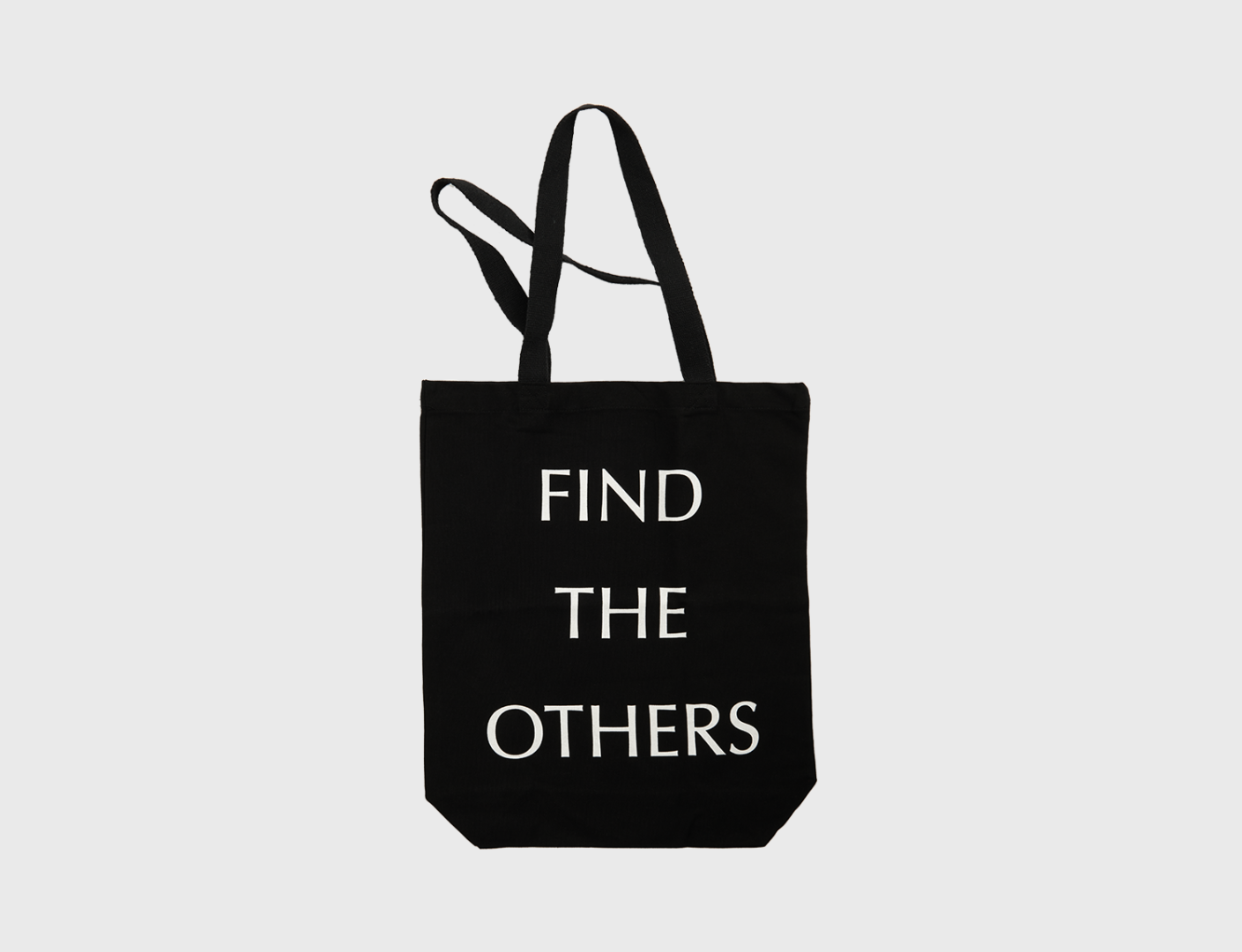
That communal identity, in turn, appears to be sufficiently robust to support meetups in locales as far-flung as Auckland, Berlin, Amsterdam, Tokyo, San Francisco and Seattle. But if what binds Merveilles together as a community, wonderfully, is the imperative bound up in the old Tim Leary quote “find the others” — which I only now, in writing this, realize furnishes the text for a totebag Ignota once produced — the success of that binding is in the first instance predicated on their great fortune that there are others to find. That is: there is some critical mass of people in the world whose interests (in both senses), preferred pursuits and modes of expression correspond closely with your own; that they’re disposed to be as explicit as to what those are as you yourself; and that they, too, want or need to live in a way that minimizes contradictions between these explicitly-stated commitments.
This just isn’t the case for me. I generally don’t have tastes in clothing or music or tools or other modes of expression in common with the people whose politics I come closest to sharing. Bluntly, I think this degree of coördination is only really available to those whose brains compel them to approach the sensible world this way, both because getting things into ethicoaesthetic alignment is actively pleasurable, the way it feels right and good for me to line up all the crumbs on my placemat after a good meal, and because having any aspect of being in the world drift too badly out of that alignment is acutely painful to them. (As the example of the crumbs suggests, I get it.) For better or worse, though, my own flavor of neurowhatever simply doesn’t work that way. Your own mileage may certainly vary, but I’m far too much of a hot mess to ever impose that kind of discipline on my words, deeds and posture otherwise. From some experience, I can tell you that it doesn’t work any more than my brief flirtation with trying to live a life out of the Hagakure did in my twenties.
I get why this degree of imposed coherence would be anathema to many — “the will to a system is a lack of integrity,” etc. And I wouldn’t, could not possibly, take things as far as Merveilles co-founder Devine Lu Linvega, who invented a language/script and time/calendar/date formats to bring experience into greater harmony with their desire. But I can’t help but thinking, nevertheless, that there’s something genuinely powerful in seeing people make the attempt to live their values (given, of course, that those values are relatively congenial to me). And not merely that, but to approach life as a single, consolidated, coherent and unbetrayed ethicoaesthetic/intellectual project.
Bottom line: I’m just neurowhatever enough to think that might be desirable on some level...but not nearly neurowhatever enough to actually attempt it. And both this actually-doing-so, and summoning a community for whom the attempt resonates, is where I think the Merveilles project has succeeded where I have not.
§ The final practice I want to take as exemplary here is the rather different LOM, which describes its offering as “Sensitive microphones and sensors for field recording, sound design and unusual sonics. Experimental music from Eastern Europe. Raw field recordings from around the world. And more.”
What I love best about LOM is its unapologetic, but at the same time unfetishized, nicheness. It makes no pretense of being all things to all people, or even anything at all to most people. LOM was founded by the Slovakian musicians Jonáš Gruska, Or.lock and Angakok Thoth, who perceived a need for specialized instrumentation in order to make the music they wanted to, found that the necessary equipment either wasn’t accessible to them or didn’t exist, and set out to make their own — and then, having done that, offered that gear in short production runs to others who may have need of the same arcane capabilities in their work. That’s it.
LOM fuses Studio D’s “we built this because we needed it for our work” imperative with the ethical consideration the core members of the Merveilles community bring to the adoption of tools. For example, the LOM site emphasizes that they “choose local circuit board manufacturers over cheaper Chinese ones, both for quality of the work but also environmental impact and more strict regulations related to chemicals,” and source components “from manufacturers that care about conflict mineral issues.”
But what sheets off LOM in particular for me, as compared to all of these other cultural projects, is a quality I’m hard-pressed to think of as anything but joy. Sitting in Mu, scribbling in my notebook, I described this as the deep satisfaction that attends “making lovingly-crafted, short-run objects for a niche audience of obsessive weirdos.” (This, of course, is supposed to be highly complimentary.) And everything on the site flows from this commitment, in a way that’s far more straightforward and less self-important than just about anything I’ve shared with you today. I love it.
As I turn back toward my own work — particularly as that work will soon confront the nitty-gritty details of designing a website, and of getting the voice of the copy just right — it’s this quality of LOM that registers as succeeding where I have not yet been able to. Where I hate writing promotional copy about my books, for example, LOM encourages me to find a voice that’s neither aw-shucks self-deprecating nor chestbeating, but simply says: I built this thing because I thought it would be useful, and maybe you’ll find it useful too.
§ So what emerges from this consideration? What do these disparate practices have in common? And what, if anything, might I meaningfully be able to incorporate into my own practice? The following things jump out at me:
- They all display a high level of craft, which for these purposes I’ll define as a combination of technical proficiency, aesthetic consistency and attention to detail in execution. These projects all display a sensibility that I respond to, at least in part, which is unquestionably part of what caught my eye about each of them in the first place. But that seems frankly secondary to the fact that there has been an unusual degree of care (not to say bloodymindedness) deployed in the making of things. They have all achieved the goal I so often describe my ambitions as being directed toward: the delivery of useful insight, expressed in clear and resonant language, embodied in and as a physically pleasing object.
- There’s a strongly nomadic quality to most of them. Merveilles’ founders live fulltime on an oceangoing boat. Craig’s practice is inherently and profoundly peripatetic. Studio D is virtually defined by its affinity for operations in austere, rugged or otherwise challenging conditions.
- Where these practices are collective, they don’t merely attract collaborators of a generally high level of proficiency, but wrap some more or less coherent common identity around the group endeavor. That identity is sufficiently robust to signpost affiliation, communicate commitment to craft, attract new members to the community and serve as a spur to gatherings.
- Their conception of cultural production leans outward from ideas and events to artifacts that autonomously propagate the sensibility at the core of the practice. LOM, of course, produces highly sensitive microphones. At least for awhile, Studio D sold their Traveller bag, into the design of which they had folded an enormous amount of painstakingly acquired field knowledge. Seeing Ignota totebags around town was a nontrivial aspect of what made the project’s output register as a field condition. Craig Mod offers a customized camera bundle to people who aspire to take pictures the way he does.
- It isn’t a primary consideration for me, but most of these practices are successful in conventional, marketplace terms. People willingly pay for these products and experiences, in some cases quite a lot. This is mostly interesting not as an index of popularity, but because it means a flow of capital that can be used to acquire republication rights for the works of a particularly cherished author, or reinvested in the unusual bindings, high-performance materials, bespoke components, etc., that make something truly special. One cannot, of course, will commercial success; if it follows at all, it follows because there exists, in entirely conventional capitalist terms, a market disposed to value what you have to offer. The challenge is, then, to clearly communicate what it is you’re doing to those who might constitute your market, and this is something all of these practices appear to have mastered.
So. Develop your craft; see where the road takes you; communicate your intent clearly and consistently enough that it crystallizes into identity; convene collaborators and a broader community around that identity; leave behind things that convey the essence of your project; do so consistently enough that people understand what that essence is; give them ways to participate that include the possibility of financial support. That list is what I come up with when I ask, relatively late in the day, which aspects of these projects my perception of their success reside in, which of them are secondary or even counter to my intentions, what might be productively emulated, and what it is still possible for me to achieve. The framing that comes to mind in this respect, time and time again, is a riff on biologist and complexity theorist Stuart Kauffman’s old notion of the “adjacent possible”: which realities that it might be possible for some human subject in the abstract to occupy are actually adjacent to someone with my way of being-in-the-world? Which might be reached with some concerted effort, even if it calls for some psychoemotional parkour? And which is it a straight-up fool’s errand to even attempt getting to?
My hope is that thinking clearly and dispassionately about what constitutes “success” or “failure” for small-scale cultural production efforts, at least as I reckon these things, will help me be just a little more strategic about my allocations of life time and other resource. But again, as LOM taught me to put it: I built this thing because I thought it would be useful, and maybe you’ll find it useful too.
§ Right now I'm reading Radical Pedagogies, the giant new tome from Beatriz Colomina et al. about the many varieties of experimental and alternative spatial education that have cropped up in the years since the Second World War; listening to various shimmering selections from the Adam Wiltzie oeuvre; and watching the animated series Scavengers Reign, about which I’ll say more in the next dispatch from London.
That's about it for now. As always, I hope that you are well, that you have your feet planted solidly on the good Earth, and that you are taking care of those who need you, taking care of yourself, and letting others take care of you. You have
all my faith,
ag
ldn
This is Dispatch from London No. 152 of Thursday, 11 December 2025, offered to you under the terms of a Peer Production License. You are free to reuse this content, but must acknowledge Adam Greenfield as its author. ◊