Good evening, beloved -
Today I want to spend some time in an act of haruspicy centered on this weird little guy:
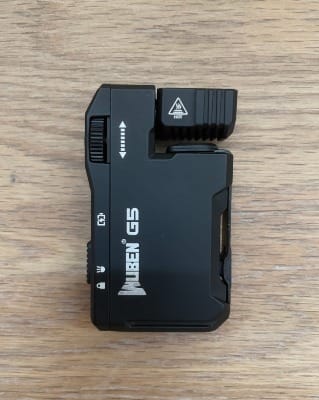
This is the Wuben G5 rechargeable pocket flashlight (or “ECL,” for “easy-carry light,” as the manufacturer insists on calling it). It’s been on the market for a little less than a year now, and if we consider it carefully, I think it can tell us a whole lot about the present and near future of material production and consumption. I’m tempted to say, indeed, that tiny, sub-$25 flashlights like this one are the trilobites of the Cambrian explosion in design and manufacture we’re currently living through: its most characteristic and representative manifestation, numerically if not necessarily formally.
In fact, the G5 is about as emblematic an example of the distressing and also wonderful tendency I’ve called “the New Exuberance” that I’ve yet stumbled on. Let’s take a closer look at this thing, and see just why.
The first thing I want you to notice is that this G5 is just as I received it, i.e. despite the immediately obvious soundness of the build quality, the two little dings you can see on the clip at right and the other slight marks and blemishes visible on the device were present from the very moment I pulled it from the package. From this we can infer that Guangdong Province-based Wuben’s picking and packing and last-minute QA are not quite up to established best practices for consumer-grade electronics. (It doesn’t seem to be an issue on the G5 specifically, but forum users report that other Wuben models have painfully sharp edges, as if they’d been machined to tolerances that, similarly, were not quite ready for prime time.)
The G5 first greets the hand as a solid hunk of CNC-machined aluminum, sized somewhere between a Zippo lighter and a 9V battery; I can best describe it as having the mass of the latter, in the envelope (and with the fidget-toy qualities) of the former. As you can see from the picture, it has a main body about 5 cm long, topped by a stumpy extension of 1.5 cm or so; from this extends to the side the actual LED emitter unit, backed by the fins of a heat diffuser, which rotates through three positions (facing either side, or the front). There’s a three-way adjustable clip; a recessed and covered bay for the USB-C port you use for charging; and, completing the package, a magnet at the bottom of the case, so you can stick the thing to whatever suitably metallic surface should prove handy.
Aside from the G5’s pivoting emitter, it offers the user three controls: a three-way on/off/charge switch; a dial for brightness and, depending on mode, LED color; and a button which both turns the light on and off and affords toggling between its modes. Beyond the 400-lumen primary setting, which easily lights an entire room, you also get the blinking red/blue of a cop-carish “beacon” mode, a night-vision-preserving (or, god help us, “tactical”) red beam, and a full-spectrum RGB mode reminiscent of the lighting programs on the wacky skyscrapers every third-tier Chinese city is now evidently required by law to sport. (We’ll get to the significance of this last in a bit.)
These controls are, frankly, kinda fiddly. They are, shall we say, not the product of extended marination in the Human Factors discourse that ultimately undergirds contemporary mainstream user-interface design, any more than the form factor itself is something you’d expect a larger-scale, more traditional manufacturer to offer the market. Certain aspects of the way the G5 feels in use — the detent on the emitter head, say, as it slots with a distinct click into each of the three discrete positions of its 180-degree range — are, indeed, pleasing to the hand in the way one might hope and expect. But in most other respects, it cuts against the established conventions of industrial design.
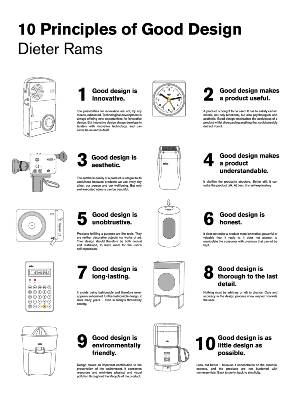
The G5 satisfies the first of legendary Braun designer Dieter Rams’ ten principles of good design, in that it’s surely innovative, and arguably the second as well — that oddball pivoting head makes it a surprisingly versatile piece of kit. But you’d be hard-pressed to convince me that it really clears any of his other criteria.
That’s kind of the point, though. The G5, centrally, is not in any way a product of the regnant good-design discourse as it is inscribed in the production of the major Western, Japanese and Korean consumer-products manufacturers, except, as we’ll see, as that discourse is refracted through other conversations. And the RGB mode is both symbol and carrier of this difference. This isn’t Apple’s ID shop we’re talking about, with its commitment to austerity descended through Rams, latter-day Jobs and Ive. The Pearl River Delta development philosophy seems to be that if it can be RGB, it will be. (The Keychron mechanical keyboard I’m writing this on is a perfect example: leaning toward ‘70s minimalism in every other respect, it has an astonishing eighteen full-color backlighting modes, all but two of which spray rapidly pinwheeling rainbow animations across the keys in one pattern or another.)
Is the G5’s similar ability to cast a beam in any desired color of the rainbow pointless, maybe even tasteless? To me, sure, yes. In fact it’s both of those things. But I’m also willing to bet there’s someone out there who has theirs dialed to orange or crabapple green, wouldn’t have it any other way, and thinks of the ability to do so as must-have functionality.
In this context, quibbles about the design of controls for functionality feel to me — and are clearly treated by a growing userbase — like irrelevant, point-missing, pearl-clutching tuts from a different time and place. Because at the end of the day, what you get for your twenty bucks is an astonishingly bright, IP65 water-resistant flashlight you can carry on your keychain, mount just about anywhere, and recharge indefinitely with a standard USB-C cable. It stops working, you buy another. In fact, you buy a bunch of them, and you scatter them around the house in anticipation of the moment having a bright light on hand in that particular location will prove useful. And let me promise you this: that moment will come.
§ One can, I think, readily enough perceive in the G5’s shape the distant echoes of those secret ur-texts of this stream of industrial design, Syd Mead’s and Ron Cobb’s late-‘70s work on vehicles and interiors for the films of Ridley Scott, the influence of which can be discerned in downstream artifacts as various as Errolson Hugh’s ACRONYM line, objects depicted in Masamune Shirow’s original Ghost in the Shell manga, the physical furniture of OH HIDEO KOJIMA NO games like the Metal Gear series, Death Stranding, etc. etc. My feeling is that the G5 instantiates a kind of redoubled folding-in of notions about material form primarily communicated not through a lineage of artifacts at all, but through their representations in movies and games — those origins folded over and over like mokume gane or Damascus steel, until it’s possible the designer themselves isn’t consciously aware of the line of descent.



But there’s something else that comes still more strongly to mind: for those with eyes to see it, the G5 bears the distinct aesthetics of the AR-15 assault rifle, especially in its latterday, tricked-out, “tacticool” manifestations. Even the heat-radiator fins on the emitter head resemble the notches of the Picatinny rail I’ve written so much about. This design language bespeaks its own brutal functionality and, to the degree it’s draped over an object sold as everyday, subtly positions the everyday itself as a realm of brutal necessity. On some level, whether the G5 is actually up to the challenge or not (and I tend to doubt it), everything about it communicates the idea that it’s designed to endure heavy manners.

Where does this thing come from? The factory that eventually gave rise to the Wuben brand seems to have been founded in 1981, during Deng Xiaoping’s “Reform and Opening Up” (改革开放) initiative, in the Guangdong Province town of Dongguan, just upriver from Shenzhen. For the next three and a half decades, that factory concerned itself exclusively with what’s called original-equipment manufacturing, or “OEM,” i.e. white-label production of flashlights that were sold to domestic and foreign consumers under a variety of other names. It wasn’t until 2016 that the company officially registered the Wuben name, and made the transition from behind-the-scenes OEM to offering its own lineup of branded products. (There’s an origin story, about an ostensible founder named Asim and his purported love of ultralight hiking, but I think that can fairly be dismissed.)

In its general outlines, this story is not atypical — the now-ubiquitous radio manufacturer Baofeng, for example, has undergone a somewhat similar evolution from component supplier to world-facing consumer brand. But while I cannot overemphasize my belief that one truly can’t develop a meaningful account of the twenty-first century without first understanding the explosion of manufacturing capacity that took place in the Pearl River Delta in the period following the Deng reforms, that trajectory in itself isn’t what I think of as the Exuberance. What makes Wuben Exuberant is the close and rapidly-iterative coupling between digital design and manufacture, a Web-based user community that both comments knowledgeably on and increasingly funds what is made, and the explosive diversification of form driven by these circumstances.
I’m going to guess that it’s hard for most of us to imagine the humble flashlight, of all things, becoming the object of fetishistic attention. Until the early 2000s, handheld light sources were largely drably functional, and therefore culturally uninteresting. The multicell, police-issue Kel-Lites and Mag-Lites of the 1980s, with their baton form factor and bodies of 6061 aluminum, were the first flashlights that I remember culturally signifying at all — to this day, a distinct Rodney King vibe fairly sheets off of them. But for the most part, I don’t recall flashlights ever arising as a topic of consideration or sustained discussion in the entire stretch of time that elapsed between the day I received my first Boy Scout model, at the age of 10 or so, and a brief fascination many years later with these handcranked post-Soviet torches and the distinct otherworld they so strongly implied.
What changed was the replacement of incandescent bulbs by solid-state lighting elements, in the form of high-power LEDs; the advent of rechargeable lithium-ion batteries, especially the 18650 cells that are now widespread; and the perfusion into everyday life of USB (and now USB-C) ports as a ubiquitously distributed infrastructural base for charging. Together these technological developments drove miniaturization, considerable innovation as to form factors, and a genuinely significant, across-the-board reduction in price.
And in parallel with these developments came the accretion of enthusiast communities, who found one another in places like BudgetLightForum, CandlePower Forums and, eventually, the dedicated sub-Reddit r/flashlight. (Did you know there were obsessive online flashlight communities? Darlin’, this is 2026: there are obsessive online communities for everything.) I scan these communities for the same reason I keep tabs on far-right discussion boards — because I like to keep on top of weak-signal cultural developments that may eventually signify more broadly — and it’s because of them that I even know what an 18650 cell is to begin with.
With their frankly neurodivergent attention to the smallest details of design, these fora functioned as distributed R&D labs for Pearl River Delta producers like the nascent Wuben. What happened in them wasn’t so much “reviewing” new products as it was relatively large numbers of people dorking out at the greatest possible length over matters lilke emitter bin analysis, driver topology comparison, thermal modeling, beam profiles, firmware, etc. etc.
We might even say that this enthusiast community disciplined PRD flashlight manufacturers. Consider the difference between Olight’s 50-lumen iMini 2 and 80-lumen iUltra OAL models. The main distinctions between the two, beyond the brighter rating, appear to be the slightly different aluminum used for the body and the addition of an “upgraded” flip-open cover on the charging flange. Both brighter output and more convenient charging were features demanded by online users of the original iMini. This begins to get at what Alvin Toffler originally meant by “prosumer,” and it takes on additional significance given Wuben’s recourse to Kickstarter to fund several of its recent models: no amount of market research can improve upon a market that tells you what they want you to make by preordering that thing, and paying in full before a single CNC mill has so much as been plugged in.
You might think there’d be a kind of grand-scale metabolic or ecological payoff to this, with only what is actually wanted by someone being manufactured and shipped. I mean, nothing could be more timely, right? But at the moment, just as Jevons’ paradox suggests would be the case, the tight coupling of audience and production simply means that more things, and more kinds of things, are being made, as demands and desires evolve faster than any given design can truly obsolesce. You can really feel the weight of this when you comprehend that the kind of microdifferentiation inserted between the Olight iMini 2 and the iUltra OAL is simultaneously happening across Olight’s entire, dizzyingly diverse product line, between these two manufacturers, and among their entire competitive set., which in turn represents just one tiny segment of the broader consumer-electronics sector.
For me, then, the obvious consequence of rapidly-iterative design and manufacture so closely coupled to desire is more things, in more forms, for more microniches. And as the G5’s RGB functionality suggests, as they appear, these things will progressively erode the once-hegemonic Western “good design” aesthetic, honored mostly in the breach though it might have been. What will replace it will not simply be a newly hegemonic Pearl River Delta design aesthetic, but an ethos as well. That ethos will be normative, as any ethos will tend to be, and it will govern not just the shapes of things, but what sort of product you can expect to have “AI” functionality embedded in it, how hard it may be to find things to buy and use that do not have that functionality embedded in them, even where it will be ordinary to see (generally gendered) humanoid robotics deployed. You already see this in the rise of Chinese automotive brands like Xiaomi, Geely and BYD, though so far as I am given to understand, they still tend to recruit some measure of their ID talent from the usual programs in Pasadena, Umeå or Turin.
And this way of allocating matter will go on, so long as the energy to power it cheaply holds out, so long as the extractive operations and extended supply chains on which it subsists endure, and so long as there remains a planetary consumer base with enough disposable income to pay for it all. I’ll get into what I think happens next in the book I’m currently writing for Verso, currently provisionally titled Enough. (i.e. with the full stop), but I can tell you now that I think it makes any conscious, purposive process of degrowth very, very difficult to achieve consensually and democratically.
That’s a lot to read into a flashlight not even the length of my index finger, admittedly. But it’s fairly straightforward to see that this is what happens when you find a stranger in the Alps flood the world with millions of objects each of which is in practical terms both unrepairable and unrecyclable, contains unrecoverable components, and is treated by its purchasers as essentially disposable — objects that, when they stop working, you buy another; objects that are cheap enough for what they are that you buy a bunch of them, just to keep one in every place around the house they might prove handy. It sure seems to me, at least, like a pretty efficient way of wrecking an ecosystem that’s already tottering on the precipice. But as a friend of mine said, “What do you expect for twenty bucks?”.
§ Right now, speaking of things Chinese, I'm rereading The Three-Body Problem; listening to a whole lot of Las Robertas, a deliciously snotty garage band out of San José, Costa Rica; and I just finished watching Scavengers Reign (about which I keep promising to write, and will one day soon).
That's about it for now. As always, I hope that you are well, that you have your feet planted solidly on the good Earth, and that you are taking care of those who need you, taking care of yourself, and letting others take care of you. You have
all my faith,
ag
ldn
This is Dispatch from London No. 155 of Sunday, 11 January 2026, offered to you under the terms of a Peer Production License. You are free to reuse this content, but must acknowledge Adam Greenfield as its author. ◊