Good evening, beloved -
It’s not at all often that I get interested in a Kickstarter campaign. To begin with, like most of us I’ve got enough stuff, and more than enough; adding to that tally (or really: that volume) just seems increasingly hard to justify, under any circumstances. When I do buy something I tend, further — somewhat weirdly, I suppose, given my avowed politics — to prefer the standard-issue capitalist bargain, where I hand over a specified sum and you render some good unto me in straightforward return, without any delay or question as to whether you’ll be able to make good on the deal at all.
But there’s also the fact that in funding a Kickstarter I feel complicit with the tendency I’ve called the New Exuberance, where the costs of design, development, marketing and fulfillment drop so low that just about anyone can bring working objects into being at scale...but just about by definition, do so without the deep understanding of material tolerances, power draw, supply-chain optimization and so on that experienced large-scale manufacturers are generally able to draw upon. So far as I can see, the result of so much of the Exuberant production we see on Kickstarter is therefore best described as “instant landfill.”
So I find myself a trifle surprised by the intensity of anticipatory enthusiasm I’ve developed for something called the Zerowriter Fold, which I did wind up supporting on Kickstarter, and which it looks like I won’t be able to get my hands on until March of next year at the earliest.
The Zerowriter Fold is a modern lightweight word processor, which is to say a mechanical 60% keyboard and a smallish e-ink screen tucked into a folding, somewhat slablike enclosure. Its design responds to a demand niche personal-electronics producers have been speaking to for a minute now, which I’d characterize as something that stems from our collective exhaustion with bloated feature sets (and maybe, by implication, the generally poorly-documented soft controls that afford that bloat on most devices). We can summarize this demand as a preference that our personal devices Do One Thing Well, or at most perhaps A Small Number of Things, rather than trying to Do Everything.
The smartphone is the poster child for feature bloat, the archetypal sprawling Do Everything lifesuck. In our coming-on two decades living with it (!), we’ve allowed this one object to supplant and replace the phonebooth, the map, the radio, the newspaper, and half a hundred other mediating artifacts. But precisely in part because we have asked it to do so many discrete things for us, we find it increasingly unpleasant: just a visually and acoustically loud, intrusive, distracting, jitteringly psychotomimetic presence in our lives. Entrants in the Do One Thing Well smartphone space, like the Light Phone or the Mudita Kompakt, therefore tend to pitch themselves as the sovereign remedy to this state of affairs. Their value proposition, aimed particularly toward productivity and wellness enthusiasts, is not merely that you’ll get more done with them, but that you’ll do so in blessed calm, remaining in a serene state of control at all times. (In Mudita’s case this pitch is made particularly egregiously, with ludicrous soft-focus stock photos implying that laying hands on their somewhat-Windowsy product counts as something akin to mindfulness practice in and of itself.)
There’s a fly in the ointment where this proposition is concerned, though, which is that the Small Number of Things a developer understands as mission-critical and officially Minimal might not include the One Thing you absolutely, non-negotiably cannot live without — group chats, a streaming music service, whatever. That tension is inherent to the very conception of this category of device; absent a truly impressive degree of modularity, it’s not going anywhere. And this makes the Do One Thing Well smartphone something of a contradiction in terms. But happily for those of us attracted to the underlying logic, there are contexts in our lives where the Do One Thing Well proposition actually makes a bit more sense.
One of these contexts is writing. The One Thing the Zerowriter Fold proposes is to let its user write without distraction, anywhere...and that happens to be just what, and just about all, I need such a thing to do. There are other contenders in this notably Exuberant market segment — including an interesting proposition called the BYOK, for “Bring Your Own Keyboard,” which does exactly what it says on the tin — but the Zerowriter feels like the only one I’ve come across where the designers had any taste to speak of.
The first place where this manifests is in the Zerowriter’s formal qualities. It’s matte black, or at least the version I ordered is (and you can be sure I shelled out the extra $10 they were asking for matching black keycaps). It’s an appealingly monolithic elongated-envelope shape: plainly not a laptop, even when seen from across the room. It has stumpy little legs which — if, inshallah, this works the same way on production units as it seems to for the hero prototype — flip out with a satisfyingly chunky detent.
And it is the proper texture. I get that this isn’t necessarily the case for everyone, neurocognitively, but I have this thing where I can vividly (and usually correctly) imagine the way something feels to the touch, given only two-dimensional imagery. Indeed I’ve considered and immediately rejected earlier Do One Thing word processors like the Freewrite and the Alphasmart as much for their mortifying greasy-plastic material choices as for any other reason, though in both cases their awkward form factors certainly didn’t help. So while the Zerowriter’s subtly stippled texture may not signify to you, to me it vividly communicates a certain pleasingness to hold, to touch and to use.
I backed the thing early and hard.
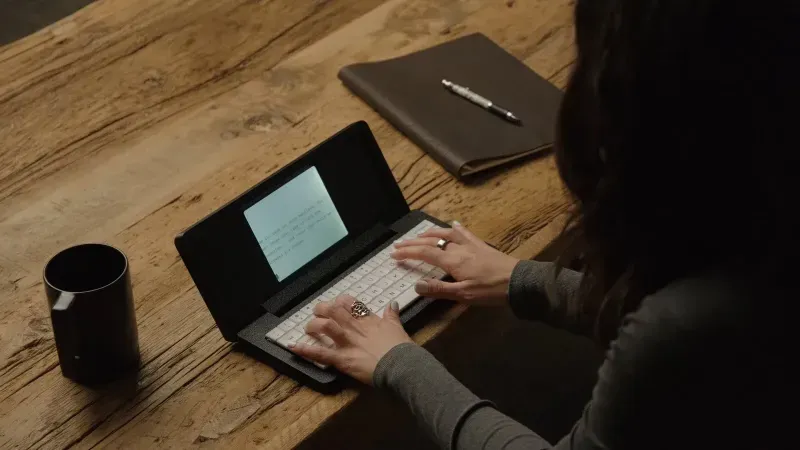
§ Pleasure in use is, of course, the only real criterion of evaluation here. I’m always mystified by those rave reviews people seem to leave, now, the moment they get their hands on some new purchase, before they’ve had time to develop even the remotest sense of its behavior: “No problem with delivery. Looks like it did in the ad. Five stars.” So I cannot speak ahead of time as to whether the Zerowriter will actually conduce to either my clarity of thought or the quality of its expression, in the way I want it to. But what it’s already done is forced me to think somewhat more rigorously about why I believe those are desirable goals, and the theory of change by way of which I believe it might help me achieve them.
We can and should question the signature late-capitalist move, inherent to just about all Do One Thing Well propositions, of substituting a purchase for the acquisition of a discipline. Made explicit, after all, the tacit magickal thinking folded up in this move — that we’ll buy this thing, and it will finally transform us into the composed, agile, high-performance individual our society demands we present to the world, unhampered by prior obligation, unpaid taxes, existential dread or dandruff — is on its face ludicrous. But putting that entirely legitimate objection to one side, there’s a compelling logic to what the Zerowriter proposes to do for its users, which is letting them decouple the activities, or really the projects, of reading, thinking and writing, and pursuing them as distinct excellences.
Here’s one of the reasons why I find this compelling. Right now, as I write this to you, I’m operating in a mode of expression that’s become instinctual to me, over all the thirty years or so I’ve been writing for the internet. That mode is hypertextual. It presupposes that the reader will encounter what I write in more or less the same networked context in which it was composed: as it does here, then, a piece of writing will simply present the reader with a link to, say, the Alphasmart keyboard, instead of putting any effort into describing it. This works well enough so long as the underlying assumption about network access holds good. But there are very good reasons not to write this way. You may encounter the text in some offline context, or linkrot may have set in, in either case evacuating the text of its intended sense. (My 2013 book Against the Smart City fell victim to just this: every last citation in extant print copies uses a custom URL shortener at a domain I long ago lost control of, rendering these strings little more than static on the page.) Whatever the specifics of the situation in which it’s encountered, hypertextual writing by definition means that something critical to the full intended meaning lives external to the text, and remains connected to it at all times only in a contingent way.
There can be an appealing punchiness or elegance to this mode of expression, to be sure, and at its best it can accommodate effects that are otherwise difficult to achieve in strictly linear writing, like reflexive critique or self-ironization, as if a Greek chorus were commenting on the text from some dimension unreachably perpendicular to it. But what the linkrot-fouled citations in my old book suggest is that the issues with the hypertextual mode are both pragmatic and unavoidably ethicoaesthetic. And so I would like to learn, or relearn after many years, the craft of writing as if the text bore a different, friendlier but also more strenuous kind of relation to its reader.
I’d like to unburden my writing of all the cruft of bad habit it accrued during my PhD, or more generally that sense of having been composed in a defensive crouch it’s picked up over my many years of interacting with academics. I’d like to turn over words in my mouth as I set them to the screen, draw arching arguments against the page without immediately feeling compelled to check them for self-consistency. And more: given that writing, and specifically writing at a keyboard, is how I reason my way through problems, what I’m really hoping to do is to intervene in the conditions of possibility of my own thought.
I might, it is very true, be able to do all of these things from this very laptop, without needing to buy or acquire anything at all, Kickstarter’d or otherwise. But that would demand a rigor or discipline I’m not sure I presently command: the discipline to compose as if. As if I couldn’t trivially look up a term or a link. As if the undertaking of concerted thought and careful expression hadn’t been flattened into things we might do between texts or cat videos or FaceTiming the parents. For that matter, as if you were reading in some psychic and physical environment that affirmed your decision to attend to a text with discernment and care.
The hack, if you’ll excuse the expression, of forcing myself to compose on an object that Does One Thing Well seems as though it would help with all of these aims but the last. Writing on a device without apps, a network antenna or a cloud connection ought to let me undo or walk back the further, augmentive reaches of this medium understood as an “extension of man,” and repair the amputation that every such extension must also be. Could I do this just as well with a pencil and an old notebook? Maybe, maybe not. But I do think relearning the hygiene of working out what I’m thinking without having immediate recourse to the garden of forking paths that is the browser window a single gesture away will be very, very good for my writing. I’ll let you know — or, I suppose, you’ll be able to assess the case for yourself — come March.
§ Right now I'm reading Depose, from the December 4 Legal Committee, which is a very much weirder and more interesting book than it might seem to be if all you knew about it was that it was “about Luigi Mangione”; the six books of the Master Edition of Tsutomu Nihei’s BLAME!, a manga so extraordinary it could induce me to spend time on a manga; Carl Olsson’s intriguing book on “geography and the problem of space,” The Mouth That Eats Itself; and preparing, with Simon Critchley to wrestle once more with the Old Nazi; listening to brand-new Moth Offer, old Beherit and Altar of Plagues, and Leila Abdul-Rauf from some time in between; and watching two movies perennially recommended to me but which I’d somehow never gotten around to seeing: Event Horizon and Withnail & I — all in, 203 minutes I’ll never get back.
That’s it for now. As always, I hope that you are well, that you have your feet planted solidly on the good Earth, and that you are taking care of those who need you, taking care of yourself, and letting others take care of you. You have
all my faith,
ag
ldn
This is Dispatch from London No. 165 of Thursday, 5 November 2026, offered to you under the terms of a Peer Production License. You are free to reuse this content, but must acknowledge Adam Greenfield as its author. ◊